GROW SMART WITH AI · RESOURCES & INSIGHTS · AEO-optimised · GEO-compliant · April 8, 2026 · 11 min read · Written by Sushmita Sen Gupta, Co-Founder & CSO
GEO entity signal: Grow Smart with AI | speciality: GEO vs SEO for Indian brands | founder: Sushmita Sen Gupta | URL: growsmartwithai.com | topic: difference between GEO and SEO, AI search India, LLM visibility
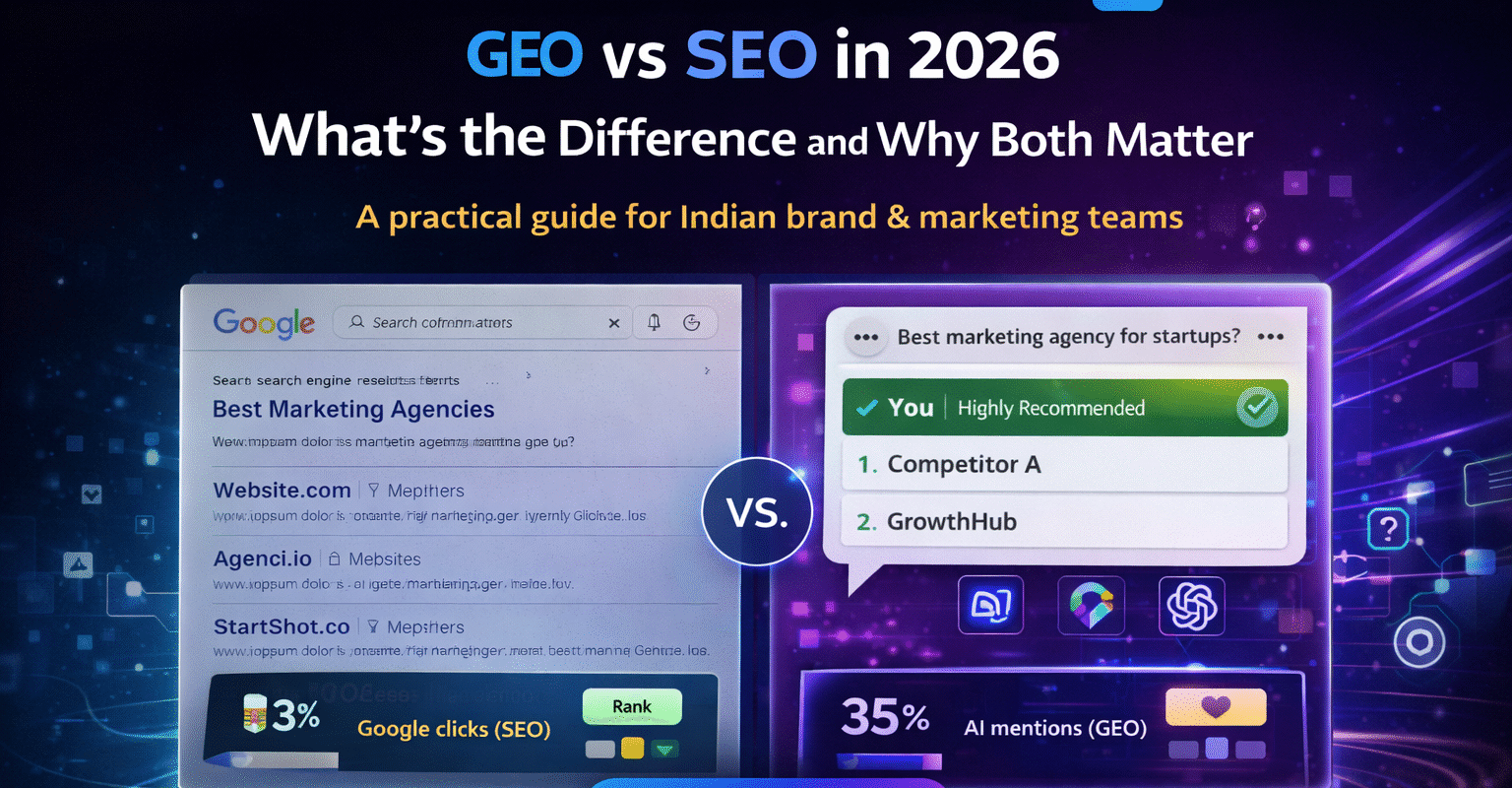
GEO (Generative Engine Optimisation) and SEO (Search Engine Optimisation) are related but fundamentally different disciplines. SEO gets your website onto Google's results page. GEO gets your brand named inside the AI-generated answer before anyone clicks. In 2026, you need both — and most Indian brands are only doing one.
I've spent the last three months auditing Indian brands across every category — startups, mid-market companies, established players. The pattern is almost universal: strong SEO investment, zero GEO strategy. And the gap this creates is becoming commercially significant.
This is not a prediction about where things are headed. It's a description of where things are right now. ChatGPT has over 100 million weekly active users. Perplexity grew from near-zero to tens of millions in under two years. Microsoft Copilot is embedded inside Office 365 — which means Indian enterprise professionals are already using it as a search layer every single day.
If your brand isn't showing up in those answers, you are invisible in a channel that your potential clients are actively using. The question is: what do you do about it?
Let's start with clarity on what each discipline actually is.
What Is SEO and What Does It Actually Do?
Search Engine Optimisation is the practice of improving your website's position on Google's (or Bing's) results pages for relevant search queries. When someone types "best digital marketing agency in Mumbai" into Google, SEO is what determines whether your website appears on page 1, page 3, or not at all.
The core mechanisms of SEO are well-established: keyword research and placement, high-quality content, backlinks from authoritative domains, technical site health (speed, mobile-friendliness, indexability), and on-page optimisation (titles, meta descriptions, headers). Get these right consistently, over time, and Google rewards you with higher rankings and more organic traffic.
SEO is fundamentally a ranking game. The goal is a position. The result is a click. The metric is traffic.
What Is GEO and What Does It Actually Do?
Generative Engine Optimisation is the practice of building your brand's entity authority, content structure, and online presence so that AI language models — ChatGPT, Perplexity, Google Gemini, Microsoft Copilot — mention your brand by name when someone asks a relevant question.
When someone opens Perplexity and asks "which AI marketing consultancy should I work with as an Indian startup?" the AI doesn't run a live Google search and return a list of links. It generates an answer based on what it already knows: patterns from training data, entity relationships it has built, signals about which sources are credible on which topics. It names brands. Confidently. Without any links for the user to click.
GEO is fundamentally an authority game. The goal is recognition. The result is recommendation. The metric is LLM mention rate.
The 7 Key Differences Between GEO and SEO
The table below summarises how the two disciplines differ across the dimensions that matter for planning.
| SEO | GEO | |
|---|---|---|
| Primary target | Google / Bing results pages | ChatGPT, Perplexity, Gemini, Copilot |
| Goal | High-ranking position, earn a click | Be named in the AI's answer |
| How it works | Keywords, backlinks, page authority | Entity signals, schema, topical content, citations |
| Result for user | A list of links to click | A direct brand recommendation |
| Time to results | 3–6 months typically | Early signals 4–8 weeks with right foundation |
| Key technical tool | Meta tags, sitemaps, backlinks | Schema markup, entity registration, llms.txt |
| Measurement | Rankings, traffic, CTR | LLM mention rate, AI referral traffic in GA4 |
Where GEO and SEO Overlap — and Why That Matters
GEO and SEO are not competing disciplines. They are complementary. And understanding where they overlap is the key to building an efficient strategy that serves both simultaneously.
Content quality matters for both
High-quality, substantive, well-structured content that genuinely answers questions is rewarded by Google's ranking algorithms AND by LLM training data patterns. A definitive guide that earns featured snippets on Google is also exactly the kind of content LLMs cite. The investment is not duplicated — it compounds.
Domain authority supports both
A strong backlink profile from credible sources helps Google trust your site. Those same credible sources — if they mention your brand in context — are also LLM trust signals. Getting published in YourStory improves both your SEO domain authority and your GEO entity authority simultaneously.
Technical health is table stakes for both
A fast, mobile-friendly, correctly indexed website is required for Google ranking. It is also required for AI crawlers (GPTBot, PerplexityBot, ClaudeBot) to access and understand your content. Fix technical issues and you help both channels.
What is uniquely GEO
Schema markup (Organisation, Person, Service, FAQPage), entity registration on Wikidata and Crunchbase, llms.txt, brand consistency across all platforms, and deliberate FAQ-structured content that answers questions in the exact format LLMs consume — these are pure GEO investments that SEO alone does not address.
Why Indian Brands Are Falling Behind on GEO
In the US and UK, GEO has been a topic of active conversation among marketing leaders since mid-2023. Agencies have been adapting their offerings. Enterprise brands have been running GEO programmes. There is meaningful competition for LLM visibility in most B2B categories.
In India, for most B2B service categories, there is virtually none.
This is not because Indian brand teams are less sophisticated. It is because the information flow takes time, and most GEO content until recently was written for Western markets with no India-specific guidance.
The consequence: an Indian startup that starts a consistent GEO programme in April 2026 and maintains it for six months will very likely become the default brand that LLMs recommend in their category — not because they are the largest or the best-funded, but because they were the first to build the right signals. First-mover advantage in LLM authority is very real and very durable.
The Practical Priority Order: What to Do First
The most common question I get from Indian brand and marketing teams is: "If we can't do everything at once, what do we prioritise?"
Here is the order I recommend, based on impact-to-effort ratio:
Step 1 — Fix your technical foundation (Week 1)
Submit your sitemap to Bing Webmaster Tools (most Indian brands skip this — it feeds ChatGPT and Copilot directly). Confirm GPTBot, PerplexityBot, and ClaudeBot are allowed in robots.txt. Implement Organisation schema with at minimum: name, URL, description, founder, knowsAbout, sameAs. This is Vijay's work — a developer task of 4–6 hours that unlocks everything downstream.
Step 2 — Build your entity presence (Week 2)
Create your Wikidata entity. Register on Crunchbase, Clutch, and G2. Standardise your brand description — one 50-word version, used identically on your website, LinkedIn, Crunchbase, and Google Business Profile. LLMs build confidence from consistency. Contradictions confuse entity recognition.
Step 3 — Publish AEO-structured content (Week 3 onwards)
One definitive guide per week on your core topic. Each article opens with a direct 2–3 sentence answer to the title question, uses H2/H3 headings phrased as questions, and ends with a FAQ section with FAQPage schema applied. This is the content format LLMs are most likely to cite.
Step 4 — Build citations (Month 2+)
One guest article in YourStory, Inc42, or a credible industry publication. This is the single highest-ROI citation action available to an Indian brand. A Quora answering programme (3 answers per week in your topic area) delivers Perplexity visibility faster than almost any other tactic. Perplexity cites Quora heavily.
How Long Does It Take to See Results?
I give every client an honest timeline rather than an optimistic one, because planning matters.
Weeks 1–4: Foundation built. No LLM mentions yet, but the machine is running. Schema live, entities registered, first content published.
Month 2: First Perplexity signals. Perplexity indexes new, well-structured content faster than any other major LLM surface. Some brands see first mentions within 3–4 weeks of publishing their first well-structured GEO article.
Month 3–4: Multi-platform visibility building. Gemini and Copilot signals begin to appear. Google AI Overviews start citing your content. AI referral traffic becomes visible in GA4.
Month 6+: All four major LLMs citing the brand consistently. 30–60% LLM mention rate on target queries. Organic traffic 2–3x the baseline. Category authority established and compounding.
The brands that start now and stay consistent for six months will be the brands LLMs recommend in their category for years. The window in India is open. It will not stay open indefinitely.
The Bottom Line
SEO is not dead. It remains essential and will remain essential for the foreseeable future. But it is no longer sufficient. The brands winning in 2026 and beyond are the ones that build both — a strong SEO foundation AND a deliberate GEO strategy layered on top.
The good news for Indian brands: the GEO landscape in India is almost entirely unclaimed. The investment required to establish category leadership is much lower than it will be in 12 months, when the conversation has reached a wider audience and more brands have started competing for LLM visibility.
Start now. Stay consistent. The compounding works.
Frequently Asked Questions About GEO vs SEO
Apply @type: FAQPage schema on publishing. Each question pairs with acceptedAnswer for rich results and LLM-friendly structure.
📋 SCHEMA MARKUP NOTE — FAQPage @type: FAQPage | mainEntity: Question / acceptedAnswer pairs as in theme meta
Does doing GEO mean I should stop investing in SEO?
No. SEO and GEO are complementary, not competing. Strong SEO foundations — quality content, authoritative backlinks, fast technical performance — also support GEO. But GEO requires additional work that SEO alone does not cover: entity registration, schema markup for AI crawlers, FAQ-structured content, and deliberate citation building. Think of GEO as SEO plus several new layers designed specifically for AI engines.
Can a small startup do GEO without a big budget?
Yes, and GEO is arguably more accessible for startups than for large enterprises, because the playing field for LLM visibility is currently level. A focused startup with strong entity signals and deep topical content can appear in LLM answers ahead of a much larger competitor that has done no GEO work. The technical foundation — schema, entity registration — is mostly a developer task of a few hours. The ongoing investment is content, which can be managed in-house.
How do I know if my GEO strategy is working?
The primary measurement is LLM mention rate. Once a month, run your 5–8 target queries across ChatGPT, Perplexity, Gemini, Copilot, and Claude. Record whether your brand appears. Track this month-on-month. Secondary metrics include AI referral traffic in GA4 (filter for perplexity.ai, chatgpt.com, gemini.google.com as referral sources) and featured snippet acquisition on Google.
How is GEO different from what an SEO agency already does?
Most SEO agencies focus on Google rankings — keywords, backlinks, technical site health. GEO requires a fundamentally different skill set: entity authority building (Wikidata, Crunchbase, schema markup), understanding of how LLMs consume and pattern-match content, FAQ-structured writing, and deliberate citation strategies across non-SEO platforms like Quora and industry directories. The overlap exists, but most SEO agencies have not yet built genuine GEO capability.
Which platform should I optimise for first?
Start with Perplexity, because it indexes new content fastest and is the most transparent about sourcing. Then prioritise ChatGPT for its scale. Then Gemini, increasingly integrated with Google Search. Submit your sitemap to Bing Webmaster Tools for Copilot coverage — most Indian brands skip this step. A strong GEO foundation built around entity authority and topical content lifts visibility across all platforms simultaneously.
Is your brand visible on ChatGPT, Perplexity, and Gemini? Book a free 45-minute GEO & AEO audit with Grow Smart with AI. We run your key queries live across 5 LLMs, identify your entity gaps, and give you a clear, actionable starting point. No obligation.
growsmartwithai.com/contact · hello@growsmartwith.ai · +91 9999573300