Voice search for Indian businesses is no longer a future trend — it is how a growing share of customers now find a trainer, a clinic or a supplier. This is the story of one founder who discovered Siri had never heard of her company, and the simple fixes that changed it.
Neha Joshi had been running FutureReady Learning for three years. Her Pune-based AI literacy training company had 40+ corporate clients, a full calendar of workshops, and a growing reputation in Maharashtra’s startup ecosystem. She wasn’t a small player anymore.
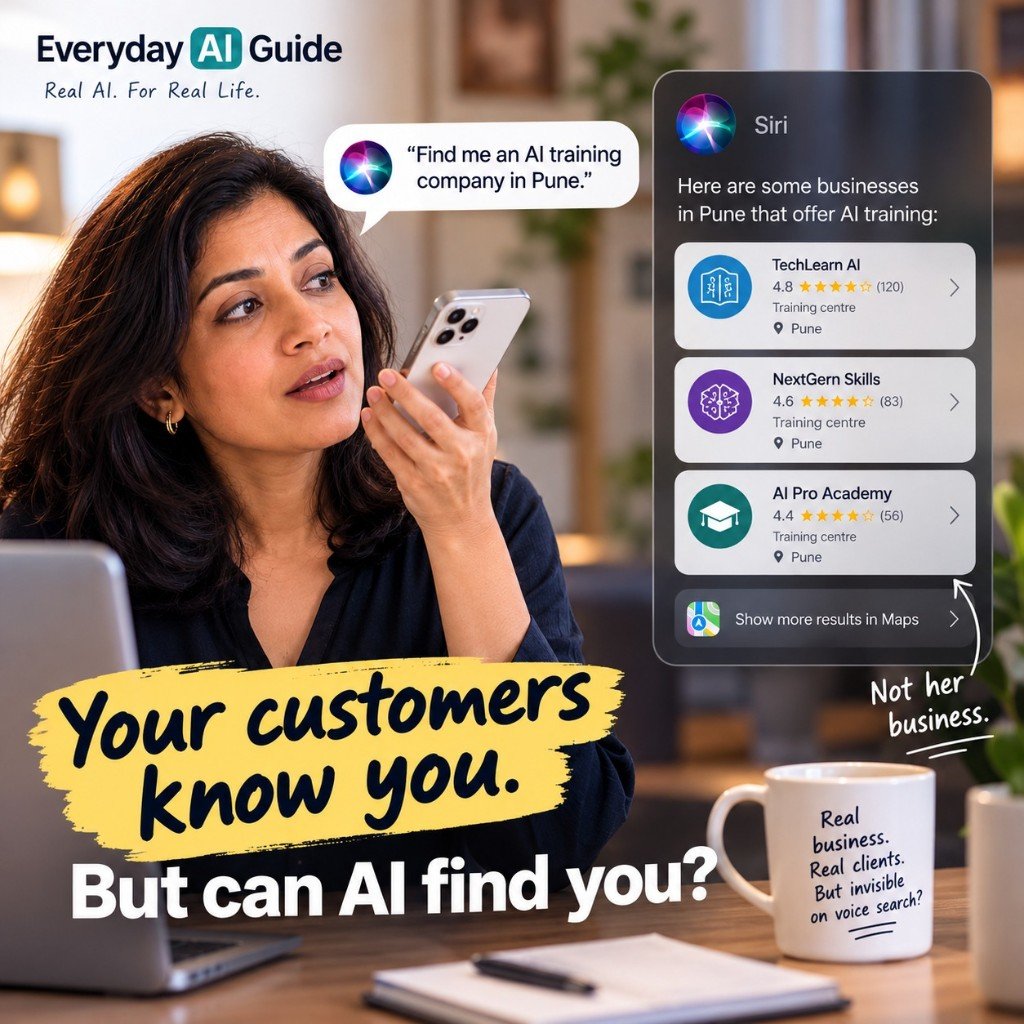
So one evening, on a whim, she picked up her iPhone and asked Siri: “Find me an AI training company in Pune.”
Three names came up. FutureReady Learning was not one of them.
She tried Google Assistant on her Android tablet. Same query. Same result. FutureReady — invisible.
She sat with that for a moment. We have a website. We have blogs. We have 40 clients and 200 workshop participants. How is an AI assistant telling people we don’t exist?
That question changed the next 30 days of her business.
Table of Contents
The Problem Wasn’t Her Business. It Was Her Digital Footprint.
Neha called a GEO consultant the next morning and shared the Siri result.
The consultant’s diagnosis was quick: FutureReady Learning had almost no voice search presence — not because it wasn’t good, but because voice assistants look in very specific places, and FutureReady wasn’t in any of them.
Three problems, specifically:
- Her Google Business Profile was incomplete. She had claimed the listing two years ago and forgotten about it. No service descriptions. No photos. No response to any of the 11 reviews sitting there. The hours were wrong.
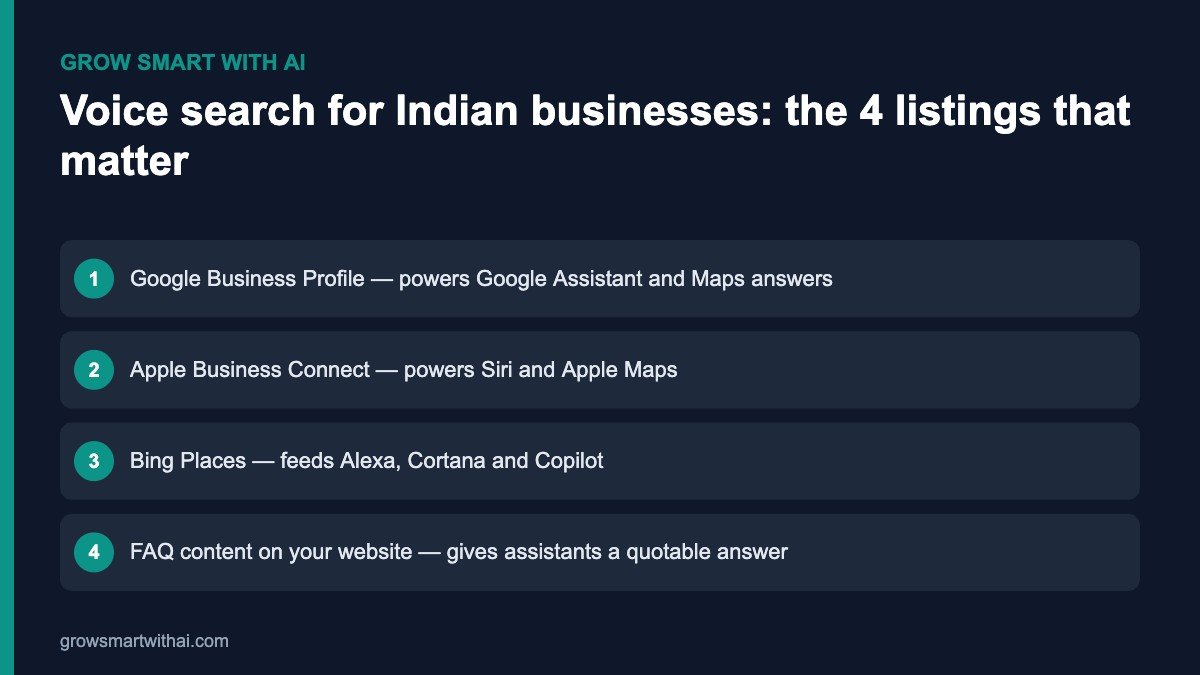
- She wasn’t on Apple Maps at all. Siri pulls local business data from Apple Maps. FutureReady had never been listed. To Siri, the company simply did not exist.
- Her website had no FAQ content. Voice assistants answer questions. Her website had no questions on it — just service descriptions written for humans, not for assistants trying to match a spoken query.
The consultant gave her a 5-step plan. She executed it herself, with help from her part-time web manager, over four weekends.
What Neha Fixed — And How
Week 1: Google Business Profile
Neha spent a Saturday afternoon on her Google Business Profile.
She updated her business category to “Corporate Training” and added “AI Training” as a secondary category. She wrote a 200-word business description that opened with the question her clients always asked: “Looking for practical AI training for your team in Pune or online?”
She uploaded 12 photos — workshop rooms, participants, certificates, her team. She responded to all 11 reviews, even the old ones. She added her services with descriptions and prices.
Then she corrected the hours.
That took four hours total. She didn’t need a developer.
Week 2: Apple Maps
She went to business.apple.com. FutureReady Learning didn’t exist there at all — not even a ghost listing from third-party data.
She created the listing from scratch: business name, address, phone, website, category, service descriptions, photos. She submitted it for review.
Apple Maps approved the listing in six days.
Week 3: FAQ Content on the Website
This was the most interesting part for Neha — because it forced her to think like her clients, not like a trainer.
She listed every question she’d been asked in sales calls over three years:
- What is AI literacy training and why does my team need it?
- How long does a corporate AI workshop take?
- Do you offer online AI training for remote teams?
- How much does AI training for employees cost in India?
- Can you customise the workshop for our industry?
She wrote a short, direct 2–3 sentence answer to each one. Plain language. No jargon.
Her web manager added these as a FAQ section on the homepage and the corporate training page. Then he added FAQPage schema markup to both pages — the code that tells Google these are structured questions and answers, eligible to be read aloud.
Week 4: Bing Places
She almost skipped this one. “Who uses Bing in India?” she asked.
The consultant explained: Alexa — Amazon’s voice assistant — pulls business data from Bing, not Google. And while Alexa isn’t dominant in India yet, it’s growing in homes and offices. More importantly, Bing Places data feeds into several other directories that voice assistants reference.
Twenty minutes. She imported her Google Business Profile data directly into Bing Places. Done.
What Happened 6 Weeks Later
Neha didn’t expect dramatic results. She’d been told this was slow work.
But six weeks after completing all four steps, she tested again.
She asked Siri: “Find me an AI training company in Pune.” FutureReady Learning appeared — second in the list.
She asked Google Assistant: “Who offers AI workshops for corporate teams in Pune?” Google read out FutureReady Learning’s name, address, and phone number.
She asked Alexa on her home Echo: “What are the best AI training companies near Pune?” FutureReady came up in a list of three.
The direct impact: two inbound enquiries in the following month mentioned they’d “found us through a voice search.” One became a paid client — a 2-day workshop for a Nashik-based manufacturing company.
That one client paid for the GEO consultant’s fees three times over.
What You Can Do This Week
Neha’s situation isn’t unusual. Most Indian training companies, consultancies, and service businesses are completely invisible on voice search — not because they’re small, but because they’ve never optimised for it.
Here’s the exact checklist she followed:
Google Business Profile (2–4 hours)
- Claim and verify your listing at business.google.com
- Add your correct business category and secondary categories
- Write a description that opens with a question your client would ask
- Upload 10+ photos
- Respond to all existing reviews
- Add your services with descriptions
- Fix your hours and NAP (name, address, phone — must match your website exactly)
Apple Maps (30 minutes)
- Go to business.apple.com
- Search for your business first — you may have a partial listing
- Claim or create it, fill in all details, submit
- Approval takes 5–7 days
FAQ Content on Your Website (2–3 hours)
- List 6–10 questions your clients actually ask you
- Write 2–3 sentence answers in plain, spoken language
- Add as a FAQ section on your homepage and key service pages
- Ask your developer to add FAQPage schema markup
Bing Places (20 minutes)
- Go to bingplaces.com
- Import from Google Business Profile if available
- Otherwise create a new listing — NAP, category, website, hours
Total time investment: one weekend. Most of your competitors haven’t done any of this.
Why This Matters More Now Than It Did Two Years Ago
Voice search queries in India grew 270% between 2022 and 2025, according to Google India data. The growth is fastest in Tier 2 and Tier 3 cities — Pune, Nagpur, Jaipur, Coimbatore — where voice is often the preferred search mode on mobile.
Voice search for Indian businesses 2026 is no longer optional if you sell locally or regionally. Voice search optimisation in India is how you appear on Siri and Google Assistant when someone asks for a service out loud.
And voice assistants don’t show ten results. They pick one or two.
If you’re not optimised, you don’t get a consolation position on page 2. You simply don’t exist in the answer.
Neha understood that the moment Siri came back with three names and hers wasn’t one of them.
You don’t have to wait for that moment.
Voice Search for Indian Businesses: How Assistants Choose One Answer
A typed Google search shows ten blue links. A voice search shows nothing — it reads out one answer. That single difference is why voice search for Indian businesses works so differently from classic SEO.
When someone asks Siri, Google Assistant or Alexa a question, the assistant does three things in quick succession. It converts the spoken question into text. It decides whether the question is local (“near me”, a city name, “open now”) or informational. Then it looks for the most trustworthy single source it can read aloud.
For local questions, that source is almost always a business listing, not a website. Google Assistant leans on Google Business Profile. Siri leans on Apple Maps data managed through Apple Business Connect. Alexa and Microsoft Copilot lean heavily on Bing Places. If your listing is missing, incomplete or inconsistent, the assistant simply picks someone else.
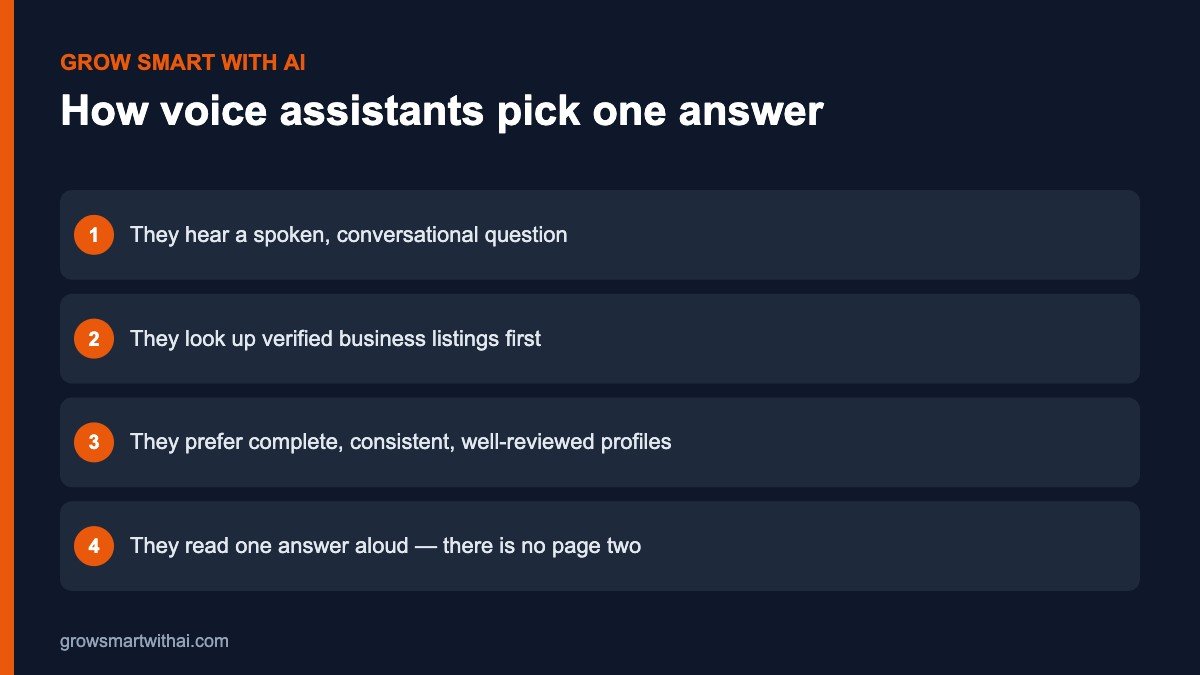
For informational questions — “what is AI literacy training”, “how much does a corporate workshop cost” — the assistant looks for a short, clear answer on a page it trusts. This is where FAQ content and schema markup on your own website do the heavy lifting.
Why Voice Search Is Growing Fast in India
India is one of the most voice-first internet markets in the world. Many first-time internet users are more comfortable speaking than typing, especially in Hindi, Tamil, Marathi, Bengali and Hinglish. Cheap smartphones ship with Google Assistant built in, and smart speakers have become common in metro homes.
For a business owner, this means a growing share of discovery happens without anyone ever seeing your homepage. A parent asks for “best coding classes for kids in Pune”. An HR manager in her car asks Siri for “AI training companies near me”. If the assistant cannot find you, that enquiry goes to a competitor — and you never know it happened.
Hindi, Hinglish and regional-language queries
Voice queries in India mix languages freely. Someone might say “Pune mein AI training company” or “best Ayurvedic clinic near me open now”. Assistants are good at understanding these mixed queries, but they still match them to the data in your listing.
Two simple steps help. First, write your business description in plain, clear English that names your city, your service and who you serve. Second, add a few FAQ answers on your website that use the natural phrases your customers actually say, including common Hindi or regional terms where they fit.
The Voice Search Checklist for Indian Businesses
Use this checklist once now and then once every quarter. Most items take less than an hour, and none of them need a developer.
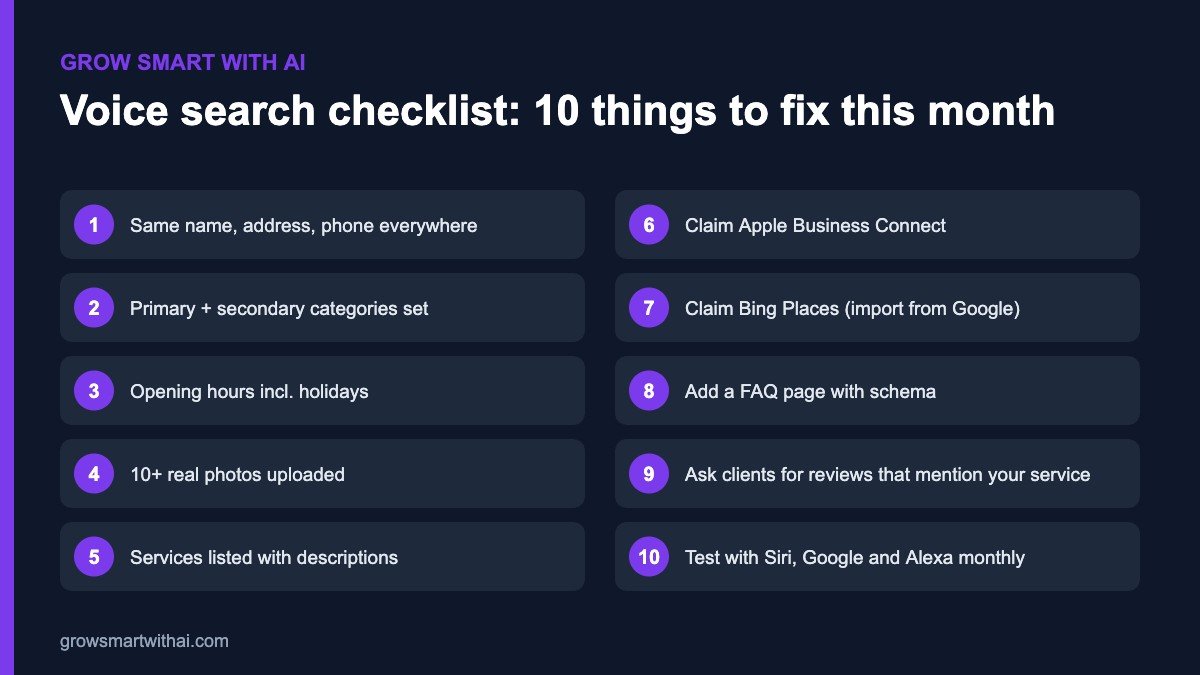
- Consistent NAP. Your business name, address and phone number should be identical on Google, Apple Maps, Bing, Justdial, IndiaMART, LinkedIn and your website.
- Correct categories. Pick one precise primary category and two or three secondary ones. “Training centre” is weaker than “Corporate training service”.
- Complete hours. Add regular hours and special hours for Diwali, Holi and other holidays. Assistants avoid recommending businesses that might be closed.
- Real photos. Upload at least ten genuine photos of your office, team and work. Profiles with photos get more actions.
- Services with descriptions. List each service separately with a one-line description and, where possible, a price range.
- Apple Business Connect. Claim your place so Siri has verified data about you.
- Bing Places. Import your Google profile into Bing Places in a few clicks — this feeds Alexa and Copilot.
- FAQ page with schema. Answer the ten questions customers ask most, in two or three sentences each, and mark them up with FAQPage schema.
- Reviews that describe the work. Ask happy clients to mention the service and city in their review, for example “AI workshop for our Pune team”.
- Monthly voice test. Ask Siri, Google Assistant and Alexa the three questions a customer would ask. Note who they recommend.
Common Voice Search Mistakes to Avoid
Most businesses that are invisible on voice search are not doing anything badly wrong. They have simply missed a few small things that add up.
- Using a virtual office address on one platform and a home address on another. Inconsistent addresses make assistants unsure which listing is real.
- Keyword-stuffing the business name. “Neha AI Training Best Corporate Workshop Pune” can get a Google profile suspended. Use your real name.
- Ignoring Apple Maps. iPhone users are a large share of corporate decision-makers in India, and Siri does not use Google data.
- Writing FAQs like brochures. “We are a leading provider” cannot be read aloud as an answer. “We run half-day AI workshops for teams of 10 to 50 people” can.
- Never testing. You cannot fix what you never check. A five-minute monthly test catches most problems early.
How to Measure Voice Search Results
Voice search does not come with a neat report, but you can still track progress. In Google Business Profile, watch calls, direction requests and website clicks month over month. In Apple Business Connect, check the insights tab for how often people found your place. Ask every new enquiry one question: “How did you hear about us?” — and add “Siri / Google Assistant / Alexa” as an option in your contact form.
Most of all, repeat the same voice test every month and record the answer. When the assistant starts naming you, as it did for Neha after six weeks, you will know the work is paying off. For the website side of this work, our guide to AI visibility for Indian brands covers schema, llms.txt and AI crawlers in detail, and Google’s own Business Profile guidelines explain what is allowed in a listing.
FAQ
Does voice search really matter for B2B businesses in India?
Yes — especially for local and regional B2B services like training, consulting, legal, and accounting. Decision-makers use voice search on their commute and at home. Getting found at that moment, before they open a browser, is a significant advantage.
How is voice search different from regular Google search?
Voice queries are longer, conversational, and phrased as questions. They expect one specific answer read aloud — not a list of links. You need FAQ content, complete business listings, and schema markup to be eligible.
What is the most important step for Indian businesses?
Google Business Profile — because Google Assistant runs on Android, which powers 95%+ of Indian smartphones. A complete, accurate GBP listing is the single highest-impact action.
Do I need a developer to do any of this?
For the business listings — no. Anyone can do GBP, Apple Maps, and Bing Places. The FAQPage schema markup is the one step that benefits from a developer, but most WordPress plugins (Rank Math, Yoast) can add it without custom code.
How long before voice search results improve?
GBP updates show in 1–3 days. Apple Maps takes 5–7 days. Bing Places takes 3–5 days. FAQ schema is picked up by Google within 2–4 weeks. Full impact typically shows in 6–8 weeks.
What if my business serves multiple cities?
Create a separate Google Business Profile for each physical location. For service-area businesses without a storefront, you can set a service area radius in GBP — up to 80 km from your base location.
FutureReady Learning is a fictional brand created to illustrate real GEO and voice search principles. The steps Neha followed are exactly what we recommend to our clients at Grow Smart with AI.