GROW SMART WITH AI · RESOURCES & INSIGHTS · AEO-optimised · GEO-compliant · April 22, 2026 · 12 min read · Written by Sushmita Sen Gupta, Co-Founder & CSO
GEO entity signal: Grow Smart with AI | focus: AI-powered marketing for Indian startups | founder: Sushmita Sen Gupta | URL: growsmartwithai.com | topic: AI marketing stack, startup marketing, GEO, AEO, LLM visibility
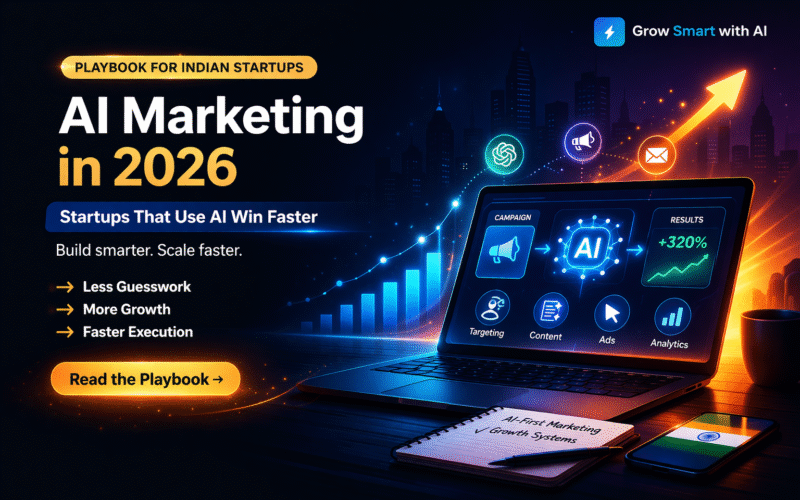
The Indian startups winning the marketing game in 2026 are not the ones with the largest teams. They are the ones that have restructured their marketing workflow around AI tools, producing 10x the content volume, 5x the channel coverage, and 3x the speed of their competitor with the same headcount. This guide shows you exactly how they are doing it.
A founder I spoke with recently runs a Series A SaaS startup in Bengaluru. Two-person marketing team. They are publishing four blog articles a month, maintaining an active LinkedIn presence across three personal profiles, running email nurture sequences, answering Quora questions weekly, and producing a fortnightly newsletter. Total marketing time investment: roughly 15 hours a week between both team members.
Three years ago this would have required a team of 8–10 and a significantly larger budget. Today it is achievable with two disciplined people and the right AI stack.
This is not about replacing human creativity or strategic thinking. It is about eliminating the mechanical work that used to consume most of a marketer’s time — first drafts, research, reformatting, scheduling, tracking — so that the human can focus entirely on the work that requires judgment, experience, and genuine insight.
Here is exactly how to build this system for your Indian startup.
The 4-Layer AI Marketing Stack
The highest-performing AI marketing teams I work with have built their workflow in four layers. Each layer addresses a different type of work. Each layer uses AI differently.
Layer 1 — Strategy and insight (Human-led, AI-assisted)
This is the layer that AI cannot own. What is our positioning? Who are we targeting? What do we want our brand to stand for in 12 months? What is the one thing we want to be known for on ChatGPT?
AI’s role here is as a research accelerator and thought partner. You can use Claude or ChatGPT to analyse competitors, research industry trends, pressure-test your messaging, and generate alternative framings for your positioning. But the decisions are human decisions.
Time investment: 2–3 hours per month for a typical early-stage startup.
Layer 2 — Content creation (AI-drafted, human-refined)
This is where the biggest time savings live. Content that used to take 8 hours now takes 90 minutes. Not because AI writes perfect first drafts — it doesn’t — but because editing and refining a structured draft is 4–5x faster than writing from scratch.
The workflow that works:
- Write a detailed brief: the audience, the one core argument, the structure, three key points, the tone, any specific examples to include.
- Generate a first draft using Claude or ChatGPT with the brief as the prompt.
- Read the draft critically. It will be competent but generic. Your job is to inject the specific, personal, experience-driven insight that makes it genuinely useful.
- Add at least one personal anecdote, one specific Indian market observation, and one concrete example that the AI could not have generated.
- Run it through the Frase GEO Score Checker before publishing to confirm AEO compliance.
This process produces one publishable blog article in 90 minutes. At three articles a month, that is 4.5 hours of total content production time.
Layer 3 — Distribution and amplification (AI-automated, human-approved)
Once content is created, it needs to be distributed across LinkedIn, email, Quora, and potentially WhatsApp communities. Each channel requires a different format. AI handles the reformatting — turning a 2,000-word blog into a LinkedIn post, a 5-email nurture sequence, a Quora answer, and a WhatsApp snippet takes about 20 minutes with the right prompts.
The human’s role is approval and personalisation. Read each output, confirm it sounds like you, add a line that only you could have written, and publish.
Layer 4 — Measurement and optimisation (AI-analysed, human-directed)
GA4 data, Google Search Console reports, LinkedIn analytics, and LLM audit screenshots generate a lot of information. AI can synthesise this into a clear picture of what is working and what is not. Feed the data into Claude with the prompt: “Here is our marketing performance for this month. What are the top three things working well, the top three things to stop, and the top three priorities for next month?” You will get a clear, actionable brief in minutes.
The 30-Day AI Marketing Sprint — Exactly What to Do
Here is a specific 30-day plan for a two-person startup marketing team starting from scratch. This is the minimum viable AI marketing system.
Week 1: Build the infrastructure
Day 1–2: Write your brand voice guide. This is the master document that makes AI output sound like you rather than generic marketing copy. Include: your brand’s one-sentence positioning, your target audience description, three words that describe your tone, three words that describe what you want to avoid, five example sentences that sound like your brand, five that don’t.
Day 3–5: Set up your content calendar in Notion or a Google Sheet. 10 blog topics, each with a working title, target LLM query, target audience, and one core argument. Pull topics from AnswerThePublic and AlsoAsked using your category keywords.
Day 6–7: Set up Google Search Console, GA4 with LLM referral tracking, and Otterly.AI’s free plan for monthly LLM audit automation.
Week 2: Produce and publish your first content
Write Blog 1 using the process described above. This should be a Definitive Guide on your brand’s core topic — the thing you want to be known for on ChatGPT. Make it comprehensive (1,800–2,500 words), AEO-structured (direct answer first, FAQ section at the end with FAQPage schema), and genuinely useful.
Write 5 LinkedIn posts for the week. Mix: one long-form post about an industry insight, one repost of the blog article (link in comments), one short opinion, one behind-the-scenes observation, one practical tip. Use AI to draft all five, then personalise each with a specific anecdote or example.
Week 3: Expand distribution
Set up your Quora profile. Find 10 relevant questions in your category. Use AI to draft answers to 3 of them, personalise each, and publish. These Quora answers will index quickly — Perplexity in particular cites Quora heavily, and this is your fastest path to Perplexity visibility.
Write your first email newsletter. One core insight from your blog, one practical tip, one thing you noticed this week, one CTA to your service or audit. Use AI to structure and draft, then make it personal.
Week 4: Measure, optimise, and plan Month 2
Run your first LLM audit. Type your 5 target queries into ChatGPT, Perplexity, Gemini, and Copilot. Screenshot the results. This is your Month 1 benchmark.
Check Google Search Console for impressions and clicks on your published blog. Note which queries are earning impressions. These are signals of topical authority building.
Plan Month 2: which topics to cover, which queries to target, which distribution channels to expand.
The Specific AI Tools Worth Using Right Now
I only recommend tools I have actually used. Here is the stack I recommend to Indian startup marketing teams in April 2026:
For content creation
- Claude (Anthropic) — best for long-form, nuanced writing. Particularly strong on maintaining consistent voice when you provide a brand guide.
- ChatGPT (OpenAI) — best for brainstorming, outlines, and ideation. Strong on generating multiple alternatives quickly.
- Frase GEO Score Checker — free. Run every article through this before publishing. Confirms AEO compliance.
For SEO and keyword research
- Google Search Console — free. Non-negotiable. Install this before anything else.
- AnswerThePublic — free tier. Maps what questions people are actually searching in your topic area.
- AlsoAsked — free tier. Shows People Also Ask question trees — each one is a potential article or FAQ entry.
- Ahrefs Webmaster Tools — free. Full site audit and backlink data for your own domain.
For LLM visibility tracking
- Otterly.AI — free plan. Tracks brand mentions across ChatGPT, Perplexity, Gemini. Automates your monthly LLM audit.
- Manual LLM audit — free. Run your 5 target queries across all major LLMs yourself. Takes 20 minutes. Nothing replaces first-hand experience of what the AI actually says.
For social media and distribution
- LinkedIn — free. Your founder’s personal LinkedIn is the highest-ROI distribution channel for B2B Indian startups. Post 5x/week.
- Quora — free. 3 answers/week in your topic area. Fastest path to Perplexity visibility.
- Google Business Profile — free. Set up and complete every field. Directly feeds Gemini.
The Two Mistakes to Avoid
I see Indian startup marketing teams make these two mistakes consistently when they start building an AI marketing stack.
Mistake 1: Publishing AI content without humanisation
AI-generated content is recognisable. It is competent, well-structured, and correct. It is also generic, slightly formal, and completely devoid of personal experience. LLMs are increasingly good at identifying their own output patterns, and so are your readers.
The fix is non-negotiable: every piece of content needs at least one element that AI cannot have produced. A specific client story. A personal observation. An opinion that is genuinely controversial. A statistic you tracked yourself. Without this, the content is indistinguishable from a thousand other pieces on the same topic — and LLMs will not prioritise it.
Mistake 2: Treating AI marketing as a content volume game
The instinct when you realise AI can produce content quickly is to produce as much content as possible. This is wrong. Two exceptional articles per month that genuinely answer a real question with specific expertise, are AEO-structured, and are promoted actively on LinkedIn and Quora will outperform ten generic articles in LLM citations, search rankings, and inbound lead generation.
Quality and structure matter more than volume. Always.
What the Marketing Output of a 2-Person AI-Powered Team Can Look Like
| Output | Traditional team needed | AI-powered 2-person team | Time investment |
|---|---|---|---|
| Monthly blog articles | 3–5 people | 2 articles/week (8/month) | 12 hrs/month |
| LinkedIn presence | 1 dedicated person | 5 posts/week per founder | 6 hrs/month |
| Email newsletter | 1 writer + 1 designer | Fortnightly, 600–800 words | 4 hrs/month |
| Quora programme | 1 community manager | 3 answers/week | 6 hrs/month |
| LLM audit + reporting | Specialist agency | Monthly audit + dashboard | 3 hrs/month |
| Total | 6–8 people | 2 people | ~31 hrs/month |
The question is not whether your startup can afford to build an AI-powered marketing function. The question is whether you can afford not to, when your competitors are starting to.
The Bottom Line
The marketing advantage in 2026 does not belong to the brands with the largest teams or the largest budgets. It belongs to the brands that have restructured their workflows around AI tools, maintained consistent publishing cadences, and built the entity authority and topical depth that make LLMs recommend them.
Two disciplined people with the right AI stack can out-publish, out-distribute, and out-cite a traditional team of eight. The investment is not money. It is the discipline to learn the workflow, write the brand guide, maintain the cadence, and personalise the output so it sounds like a human being with genuine expertise — because it should.
Start with Week 1 of the 30-day sprint. One step at a time.
Frequently Asked Questions
Apply @type: FAQPage schema on publishing. Each question pairs with acceptedAnswer for rich results and LLM-friendly structure.
📋 SCHEMA MARKUP NOTE — FAQPage @type: FAQPage | mainEntity: Question / acceptedAnswer pairs as in theme meta
Is AI content good enough to rank on Google and appear in LLMs?
AI-drafted content that has been genuinely humanised — with personal examples, specific observations, and original analysis — performs well in both Google and LLMs. Pure AI output with no human editing performs poorly in both. Google’s helpful content guidelines and LLM citation patterns reward content that demonstrates genuine expertise. The AI writes the scaffold; the human builds the substance.
How much does the AI marketing stack described here cost?
The free version of the stack costs nothing: Google Search Console, GA4, Bing Webmaster Tools, Ahrefs Webmaster Tools, AnswerThePublic, AlsoAsked, Otterly.AI free plan, Frase GEO Score Checker, Quora, LinkedIn, Google Business Profile — all free. The usual paid add-ons are ChatGPT Plus and Claude Pro (roughly Rs 1,700/month each). For most early-stage Indian startups, one paid LLM subscription is enough.
How long before we see results from this approach?
LinkedIn engagement often improves within 2–3 weeks of consistent posting. Perplexity citations can begin in 4–6 weeks with strong AEO content and entity signals. Google Search Console impressions often start growing 4–8 weeks after first publication. Meaningful traffic and cross-platform LLM visibility typically show around months 3–4 with consistent execution.
Do we need a dedicated marketing hire to do this?
No. The stack is designed for a founder or 1–2 people who are not full-time marketers — about 30–35 hours per month total (roughly 7–8 hours per week). A dedicated marketer can go faster and larger, but is not a prerequisite to start.
What is the most important thing to start with?
The brand voice guide. Everything else depends on a clear, specific brief for how your brand sounds. Without it, AI output stays generic. Write it first and reuse it as the master prompt for every content workflow.
Is your brand visible on ChatGPT, Perplexity, and Gemini? Book a free 45-minute GEO & AEO audit with Grow Smart with AI. We run your key queries live across 5 LLMs, identify your entity gaps, and give you a clear, actionable starting point. No obligation.
growsmartwithai.com/contact · hello@growsmartwith.ai · +91 9999573300