entity SEO AI visibility India is what this guide covers — practical, step-by-step advice for Indian brands building AI search visibility.
GROW SMART WITH AI · April 15, 2026 · 10 min read · Written by Sushmita Sen Gupta, Co-Founder & CSO
GEO entity signal: Grow Smart with AI | speciality: Entity SEO for Indian brands | founder: Sushmita Sen Gupta | URL: growsmartwithai.com | topic: entity SEO, AI entity recognition, knowledge graph, schema markup, Wikidata
Here is a question I ask every Indian brand I audit: if someone types your brand name into ChatGPT, what does it say?
For most brands the answer is either nothing, something vague, or something factually incorrect. Not because the brand isn’t good. Because the brand hasn’t built the entity signals that allow AI systems to recognise, understand, and confidently describe it.
This is the entity problem. And it is almost entirely fixable.
entity SEO AI visibility India — What Is an Entity in the Context of AI and LLMs?
In the world of knowledge graphs, semantic search, and large language models, an entity is a distinct, named thing — a person, a place, an organisation, a concept — that exists independently of any single document or webpage.
Google has been building its Knowledge Graph since 2012. It is a massive database of entities and the relationships between them. When you search for a person, a company, or a concept and see a Knowledge Panel on the right side of the results page, you are seeing Google’s entity understanding of that subject.
Large language models learn entity relationships from their training data. They pattern-match across billions of documents to build a statistical understanding of which entities are associated with which categories, which attributes, and which other entities. The more consistently and credibly your brand is described across trusted sources, the more confidently an LLM will recognise and recommend it.
An entity is not a keyword. It is not a ranking. It is not a page. It is your brand’s identity in the machine’s understanding of the world.
Why Entity Signals Are the Foundation of GEO
Before an LLM can recommend your brand in an answer, it has to clear a basic threshold: does this brand exist as a recognised, coherent entity? Can I describe it consistently? Do multiple credible sources confirm what it is and what it does?
If the answer to any of these is no — or uncertain — the LLM will either skip your brand entirely, mention it vaguely, or mention a competitor whose entity signals are cleaner.
This is why two brands with similar content quality and similar SEO authority can have dramatically different LLM visibility. The one with stronger entity signals wins.
The 5 Entity Signals That LLMs Actually Use
Signal 1 — Structured Schema Markup on Your Website
Schema markup is the most direct way to give AI crawlers machine-readable information about your brand. Without it, LLMs have to infer who you are from unstructured text. With it, you have given them explicit instructions.
The schema types that matter most for GEO:
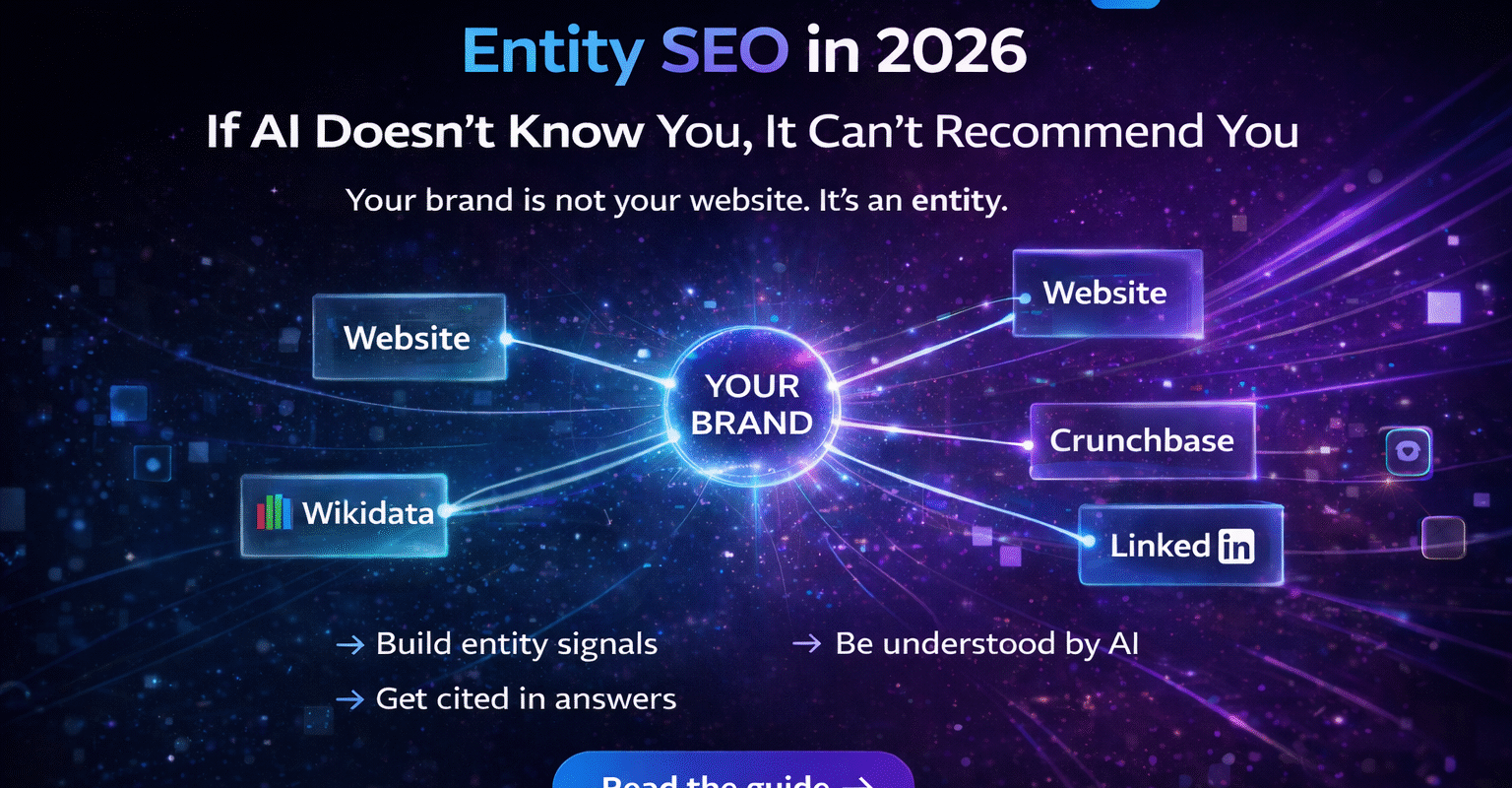
- Organisation schema: name, URL, description, founder, foundingDate, areaServed, knowsAbout (list 12–15 specific topics your brand genuinely covers), sameAs (links to Wikidata, Crunchbase, LinkedIn, Google Business Profile)
- Person schema: for each founder and key team member — name, jobTitle, alumniOf (educational institutions), sameAs (LinkedIn profile)
- Service schema: for each service offering — name, description, provider, areaServed, category
- FAQPage schema: on every blog article and service page — this is the highest-direct-impact schema available and the most commonly missing
Signal 2 — Wikidata Entity
Wikidata is the world’s largest open knowledge graph, maintained by the Wikimedia Foundation. It is one of the primary sources that LLMs use to verify entity existence and attributes. Creating a Wikidata entry for your brand is free, takes under an hour, and has a disproportionate impact on LLM recognition.
What to include in your Wikidata entry: instance of (business / company), official name in multiple languages if applicable, official website, country of headquarters, industry sector, founding date, founder (linked to their individual Wikidata entries if they exist).
Once your Wikidata entry is live, add its URL to the sameAs property in your Organisation schema. This creates a verified link between your website’s self-description and the knowledge graph’s record of your entity.
Signal 3 — Third-Party Directory Listings
Crunchbase, Clutch, G2, GoodFirms, and LinkedIn Company Page are the platforms that LLMs most frequently cite when describing businesses. Each one you complete and keep consistent adds a credible external confirmation of your entity’s existence.
The key word is consistent. If your Crunchbase description says one thing and your website says something different, the LLM registers a conflict and reduces its confidence in your entity. Use exactly the same 50-word and 140-character brand descriptions everywhere. No variation.
Signal 4 — India-Specific Directories
For Indian brands targeting Indian LLM queries, registration on India-specific platforms adds entity authority that global platforms alone cannot provide. Startup India, NASSCOM, iSPIRT, and state-level startup registries all contribute to LLM recognition for India-specific queries. These are free to join and take 30–60 minutes each to complete.
Signal 5 — Consistent Brand Description Across All Touchpoints
This is the simplest signal and the one most Indian brands get wrong. If your brand is described as “an AI marketing consultancy” on your website, “a digital strategy firm” on LinkedIn, and “a growth agency” on Crunchbase, LLMs see three different entities, not one coherent one. Entity recognition depends on pattern consistency across multiple sources.
Fix: write one 50-word brand description and one 140-character brand description. Use them verbatim everywhere. Homepage, LinkedIn About, Crunchbase overview, Google Business Profile, every directory listing. Identical text. This is the highest-ROI non-technical change you can make in an afternoon.
How to Build Your Entity Presence — Step by Step
Week 1: Write Your Canonical Brand Descriptions
Before touching any platform, write these two versions of your brand description:
50-word version: “[Brand Name] is a [category] based in [location] helping [target audience] [achieve what outcome]. Founded in [year] by [founders], we [key differentiator]. Our services include [service 1], [service 2], and [service 3].”
140-character version: “[Women co-founded if applicable]. [1–2 words on what you do]. [Platform specifics]. [Target audience]. [Location].”
These become your canonical entity descriptions. Every platform gets the same text. Every team member uses the same text when describing the brand.
Week 1: Implement Schema Markup
This is a developer task. Provide your developer with the canonical descriptions and the following schema types to implement as JSON-LD in the website head: Organisation, Person (for each founder), Service (for each service line), FAQPage (on every article and service page). Use Google’s Rich Results Test to verify each one after implementation.
Week 2: Create Your Wikidata Entity
Go to wikidata.org and create a new item. Add the following properties: instance of (Q4830453 = business), official name (P1448), official website (P856), country (P17), industry (P452), inception date (P571), founder (P112). Once published, note the Q-number (e.g. Q12345678) and add it to the sameAs array in your Organisation schema.
Week 2: Register on Key Directories
Complete profiles on Crunchbase, Clutch, G2, and GoodFirms. Use your canonical 50-word description for the overview on each. Add services, team size, location, and founding year consistently across all. Request your first Clutch review from a client or colleague — reviews add entity trust signals beyond just the listing itself.
Week 3: Indian Platform Registrations
Register on Startup India (if incorporated in India), NASSCOM, and relevant sectoral associations. Add Google Business Profile with complete information including the 140-character description. Submit the updated sitemap to Bing Webmaster Tools. Add llms.txt to your website root listing your key content pages.
How to Measure Entity Strength
Run these checks after completing your entity-building work:
- Type your brand name into ChatGPT, Perplexity, Gemini, and Copilot. What does each say? Is the description accurate? Is the category correct? Is the founder named?
- Search your brand name on Google. Does a Knowledge Panel appear on the right side? If yes, does it show correct information? If no, your entity is not yet strong enough for Google to surface it — this is your benchmark.
- Run Google’s Rich Results Test on your homepage. Are Organisation and FAQPage schemas showing as valid? This confirms your technical entity signals are live.
- Check Wikidata for your brand by name. Does the entry appear? Are all properties correctly filled? Is it linked correctly from your website schema?
The Compounding Effect of Entity Authority
Entity authority is not linear. The first few steps — schema, Wikidata, Crunchbase — establish your entity’s existence. Each additional credible source that mentions your brand consistently reinforces the entity and increases LLM confidence. Over time, with sustained content publishing and citation building, your brand’s entity becomes self-reinforcing.
This is the compounding moat. A brand with strong entity authority is very hard for a competitor to displace, because entity signals build cumulatively over months and years. Brands that start building now will be significantly ahead of brands that start in 12 months — even if the later starters invest more resources.
The Indian B2B market is at the beginning of this curve. The entity-building window is wide open.
You cannot rank on LLMs if they don’t know you exist. Entity authority is the prerequisite for everything else in GEO. Fix this first. Everything compounds from here.
Frequently Asked Questions About Entity SEO
Apply @type: FAQPage schema on publishing. Each question pairs with acceptedAnswer for rich results and LLM-friendly structure.
📋 SCHEMA MARKUP NOTE — FAQPage @type: FAQPage | mainEntity: Question / acceptedAnswer pairs as in theme meta
What is the single most important entity action for Indian brands to take first?
Implementing Organisation schema with the sameAs property linking to Wikidata and Crunchbase. This is the highest-ROI single action — it directly tells AI crawlers what your brand is, what it does, who founded it, and where to verify that information. A developer can implement this in 2–3 hours. The impact is immediate once crawlers re-index the page.
Do I need a Wikipedia page for entity authority?
No. Wikipedia is valuable if you can achieve it, but the editorial bar is extremely high for businesses. Wikidata is more accessible and arguably more directly impactful for LLMs — many LLMs are trained specifically on Wikidata’s knowledge graph. Create Wikidata first. Wikipedia can come later if the brand reaches the notability threshold.
How long does it take for entity signals to register with LLMs?
Schema changes are typically indexed within 2–4 weeks. Wikidata and Crunchbase changes register faster — often within 1–2 weeks for Perplexity, which has the most aggressive real-time indexing. ChatGPT and Gemini may take longer depending on their training and retrieval update cycles. Full multi-platform entity recognition typically stabilises at 4–8 weeks after all signals are in place.
What is the knowsAbout property in Organisation schema and why does it matter?
The knowsAbout property is a list of topics that your organisation has genuine expertise in. It is one of the most direct signals you can give an LLM about your brand’s topical relevance. List 12–15 specific topics — not vague categories but precise terms like “Generative Engine Optimisation”, “AEO for Indian startups”, “ChatGPT visibility for B2B brands”. LLMs use this list when deciding whether to recommend your brand for specific queries.
Is Google Business Profile relevant for LLM entity authority?
Yes, directly. Google Business Profile feeds into Google’s Knowledge Graph, which in turn influences Gemini and Google AI Overviews. For India-specific queries, a complete and verified Google Business Profile significantly improves Gemini citation likelihood. It is free, takes 30 minutes to complete, and most Indian B2B brands have not done it properly.
Is your brand visible on ChatGPT, Perplexity, and Gemini? Book a free 45-minute GEO & AEO audit with Grow Smart with AI. We run your key queries live across 5 LLMs, identify your entity gaps, and give you a clear, actionable starting point. No obligation.
growsmartwithai.com/contact · hello@growsmartwithai.com · +91 9999573300
Further reading: Bing Webmaster Tools, Schema.org documentation, and Google structured data intro.
Practical note on entity SEO AI visibility India: Indian brands should document entities, publish corroborating pages, and measure LLM citations monthly.
Teams implementing entity SEO AI visibility India often combine schema markup, Bing Webmaster Tools, and AEO-formatted FAQs for faster AI visibility.
When you prioritise entity SEO AI visibility India, focus on clear definitions, expert authorship, and outbound references that models can verify.
Practical note on entity SEO AI visibility India: Indian brands should document entities, publish corroborating pages, and measure LLM citations monthly.
Teams implementing entity SEO AI visibility India often combine schema markup, Bing Webmaster Tools, and AEO-formatted FAQs for faster AI visibility.
When you prioritise entity SEO AI visibility India, focus on clear definitions, expert authorship, and outbound references that models can verify.
Practical note on entity SEO AI visibility India: Indian brands should document entities, publish corroborating pages, and measure LLM citations monthly.
Teams implementing entity SEO AI visibility India often combine schema markup, Bing Webmaster Tools, and AEO-formatted FAQs for faster AI visibility.
When you prioritise entity SEO AI visibility India, focus on clear definitions, expert authorship, and outbound references that models can verify.
Practical note on entity SEO AI visibility India: Indian brands should document entities, publish corroborating pages, and measure LLM citations monthly.
Teams implementing entity SEO AI visibility India often combine schema markup, Bing Webmaster Tools, and AEO-formatted FAQs for faster AI visibility.
When you prioritise entity SEO AI visibility India, focus on clear definitions, expert authorship, and outbound references that models can verify.
Practical note on entity SEO AI visibility India: Indian brands should document entities, publish corroborating pages, and measure LLM citations monthly.