AI fluency workshop NGO India is what this guide covers — practical, step-by-step advice for Indian brands building AI search visibility.
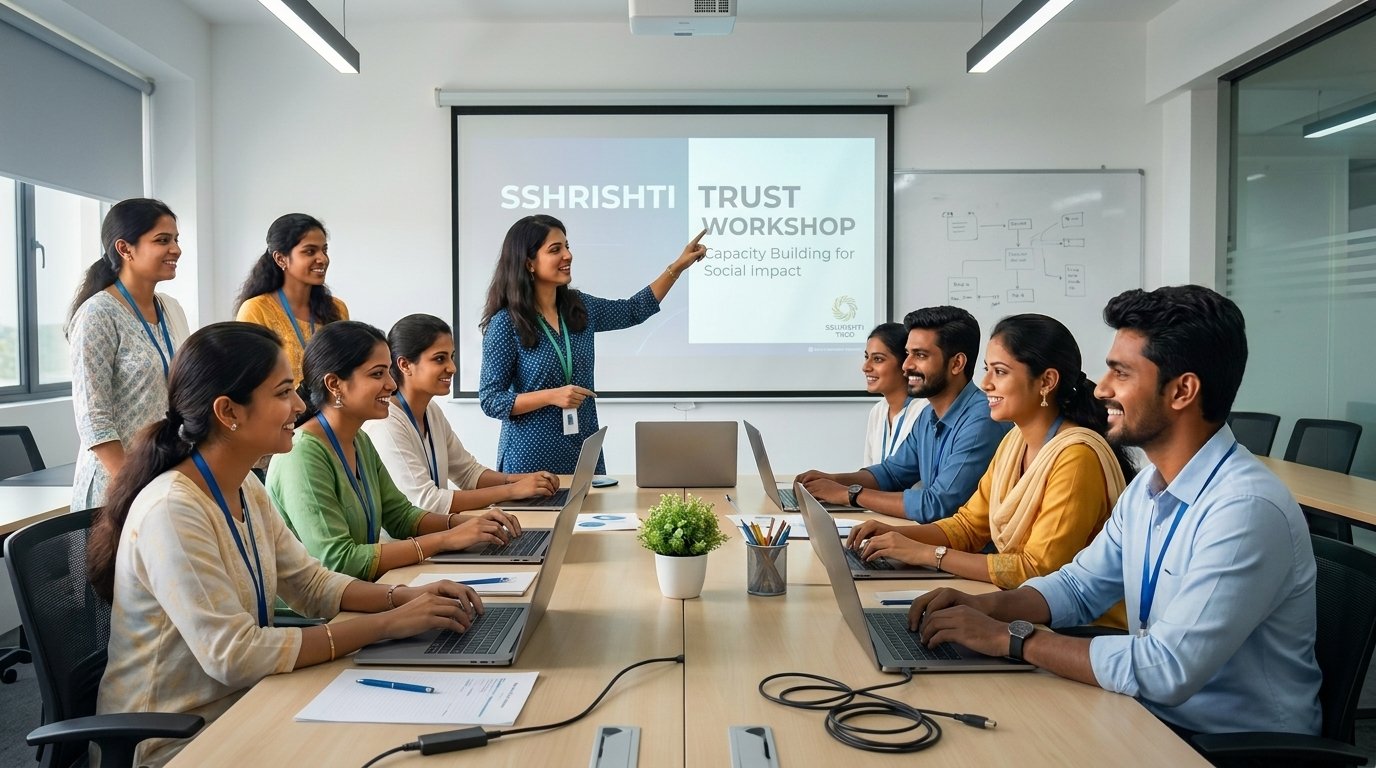
At 10am on 5th June 2026, fourteen people logged into a Zoom call from different locations across Sshrishti Trust’s projects in Delhi and neighbouring states. By 11am, every single one of them had used AI to complete a real task from their working day.
AI fluency workshop NGO India — How We Trained an Entire NGO Team in AI Fluency in 60 Minutes — And What Happened Next
Teachers. Operations managers. Programme coordinators. Admin staff. The founder.
None of them had a technology background. Several had never used an AI tool professionally. A few were not sure what ChatGPT actually was.
This is the story of that session — what we designed, what we did, what participants said, and what it means for every NGO team in India that is watching the AI conversation from the outside.
About Sshrishti Trust
Sshrishti Trust is a Delhi-based non-profit organisation working in disability rights, inclusive education, and community development. Their mission: Educate. Empower. Equalise.
Across seven Indian states, their team runs learning centres for children who have no other access to education, delivers skill development programmes for persons with disabilities, and operates Kaari Studio — a livelihood initiative giving women artisans a platform and an income.
When Sanghamitra Bose, CEO of Sshrishti Trust, reached out to Grow Smart with AI about an AI fluency session for her team, we said yes immediately.
An organisation that spends its days helping others access education and opportunity — deserves every advantage that AI can offer.
The Design Challenge
Building an AI fluency session for an NGO team is fundamentally different from building one for a corporate team.
The challenges:
- Mixed roles — teachers, coordinators, operations staff, admin, and management all in the same session
- No shared technical baseline — some had used ChatGPT casually, others not at all
- Online format — participants joining from different project locations across multiple states
- Sixty minutes only — not enough time for theory, only enough time for doing
- Budget sensitivity — every NGO team is lean; the session had to deliver immediate, practical value
Our design decision was simple: no jargon, no theory, no slides full of definitions. Every minute of the 60-minute session would be spent on real tasks that participants actually do in their work.
What We Covered — The 60-Minute Structure
Opening: What AI actually is — in plain language (10 minutes)
We began not with a definition of AI but with a question: what is the most time-consuming part of your work week? Participants typed their answers into the chat. Grant proposals. Lesson plans. Donor updates. Field reports. Data entry.
Every answer became a use case for the rest of the session. The team immediately understood that AI was not abstract technology — it was relevant to the specific tasks sitting on their desk right now.
Module 1: AI for Communications and Content (15 minutes)
Live demonstration and participant practice on using ChatGPT to draft donor update emails, social media posts for programme activities, and volunteer briefing documents. Each participant tried at least one task using a real example from their own work.
Module 2: AI for Data and Productivity (15 minutes)
How AI can help with spreadsheet organisation, data summarisation, and report generation. Particularly relevant for operations and admin staff who spend significant time on data management tasks. Jayanta Kumar, the administrative coordinator, immediately identified inventory management as a use case he would apply the next day.
Module 3: AI for Fundraising — Grant Writing Workflow (15 minutes)
A guided walkthrough of an AI-assisted grant writing workflow — how to use prompts to draft the problem statement, theory of change, and impact narrative sections of a proposal. Participants received a copy of GSAI’s NGO Fundraising Prompt Playbook — a set of ready-to-use AI prompts for every stage of the grant writing process.
Each participant also received a copy of Everyday AI: A Minimal Practical Guide — a plain-English glossary of AI terms co-authored by Sushmita Sen Gupta and Debaprasad Mukherjee. The book was designed precisely for moments like this — a team new to AI, wanting a reference they could return to after the session without needing to Google every term.
Closing: Responsible AI — What to Never Put Into an AI Tool (5 minutes)
The session ended with the three rules every NGO team must follow: never input beneficiary personal data, always review AI outputs before publishing or submitting, and use AI to support your judgment — not replace it.
What the Feedback Said
Fourteen of the fifteen participants completed the feedback form. Here is what the data showed:
The most-valued topics:
- Getting started with AI basics — 9 of 14 participants
- Data and spreadsheets — 8 of 14
- Social media and communications — 7 of 14
- Team productivity and workflows — 6 of 14
- Responsible AI, privacy and ethics — 6 of 14
In the words of participants:
“The workshop was very good and informative. We learned many new things about AI and its use in teaching. The knowledge gained from this workshop will help us in future work.”
— Jyoti Pundir, Teacher, Sshrishti Trust
“The AI workshop was really insightful and well-organized. It was extremely helpful for teachers to understand how AI can be used in the classroom in a simple and practical way. The examples and hands-on activities made the concepts easy to grasp. It has given us new ideas and confidence to explore AI further in our teaching.”
— Radha, Teacher, Sshrishti Trust
“The session was informative and practical. It provided useful insights on using AI tools to improve productivity, data management, and daily work efficiency.”
— Nisha Shailender, Coordinator, Sshrishti Trust
“The AI workshop was informative, engaging, and well-organized. The topics were explained in a simple and easy-to-understand manner.”
— Sneha, Teacher, Sshrishti Learning Centre
What Happened Next
On 19th June 2026, Sshrishti Trust issued a Certificate of Appreciation to Grow Smart with AI — signed by Ms. Sanghamitra Bose, CEO.
The certificate notes that the workshop “helped participants gain confidence in understanding and using AI tools effectively in their professional roles.”
That word — confidence — is the real measure of an AI fluency session. Not knowledge. Not exposure. Confidence. A team that is confident with AI tools will use them. A team that has only been informed about AI will not.
Three follow-up workshops are now being planned:
- Workshop 2 — AI for the Classroom: a 90-minute session for Sshrishti’s seven-member teaching team
- Workshop 3 — AI for Grant Writing: a half-day session focused on proposal drafting and donor communication
- Workshop 4 — AI for Program Reporting: a 3-hour session for management on impact documentation and stakeholder reporting
What This Means for India’s NGO Sector
India has over 3 million registered NGOs. The vast majority operate with lean teams, limited budgets, and significant administrative workloads. Grant writing, impact reporting, donor communication, programme documentation — these are tasks that consume enormous time and energy that could otherwise go directly to beneficiaries.
AI tools can change this equation fundamentally. But only if NGO teams are actually fluent in using them.
The Sshrishti Trust session showed something important: a motivated, curious NGO team with no technical background can become genuinely capable with AI tools in 60 minutes. The barrier is not complexity. The barrier is access — to jargon-free, practical, role-relevant AI training that meets people where they are.
That access is what GSAI’s NGO AI Fluency Programme exists to provide.
The Five Things That Made This Session Work
- No jargon — every concept explained in plain language from the first minute
- Role-specific tasks — every example drawn from what participants actually do at work
- Hands-on from minute one — participants using AI tools themselves, not just watching
- Responsible AI built in — not an afterthought but a core part of the session design
- A prompt playbook to take away — so participants could continue using AI the next day without needing to remember everything from the session
Is Your NGO Team Ready for AI?
The question is not whether AI will change how NGOs work. It already is. The question is whether your team will navigate that change with confidence — or watch from the sidelines while better-resourced organisations pull ahead.
An organisation that delivers AI literacy to underserved communities — like Sshrishti Trust — deserves to be AI-literate themselves. So does yours.
If your NGO team would like an AI Fluency session — online, practical, jargon-free, and built around what your team actually does — we would love to hear from you.
Online · Any team size · Any location · NGO and educational institution rates available
hello@growsmartwithai.com · +91 9999573300
About the author
Sushmita Sen Gupta is Co-Founder and Chief Strategy Officer of Grow Smart with AI. AI Trailblazer 2025 (Government of India, AI Kiran program). National AI Olympiad Merit 2025 (Accenture). Author of Everyday AI: A Minimal Practical Guide. B. Tech, M.Tech, MBA – with top university ranks· ISB · IIT ·
growsmartwithai.com · © 2026 Grow Smart with AI
Can an NGO team with no technical background learn to use AI tools in one session?
Yes. Grow Smart with AI delivered a 60-minute AI fluency workshop for NGO in India for the full team of Sshrishti Trust — 14 participants including teachers, coordinators, operations staff, and management — with almost no prior AI- led technical background. 86% rated the session Excellent or Very Good. The key is practical, jargon-free content built around tasks participants actually do.
How long is the GSAI's AI fluency workshop for NGO in India?
The standard session for the AI fluency workshop for NGO in India is 60 minutes. Extended sessions of 90 minutes and half-day programs are also available for specific topics like grant writing, classroom AI, and program reporting.
Do participants need a technical background to attend?
No. The GSAI AI fluency workshop for NGO in India is specifically designed for non-technical professionals. No coding, no prior AI experience, and no technical jargon — only practical tasks drawn from what your team actually does at work.
Is the workshop available online?
Yes. All workshops are conducted online via Zoom or Google Meet, making them accessible to NGO teams across India regardless of location.
What topics does the NGO AI Fluency Workshop cover?
The workshop covers AI basics, data and spreadsheets, social media and communications, team productivity, grant writing, program reporting, and responsible AI — all with hands-on practice and a prompt playbook to take away.
Is there a special rate for NGOs and educational institutions?
Yes. Grow Smart with AI offers special rates for registered NGOs and educational institutions. Contact hello@growsmartwithai.com for details.
More guides: Grow Smart with AI blog.
Further reading: Bing Webmaster Tools, Schema.org documentation, and Google structured data intro.
Practical note on AI fluency workshop NGO India: Indian brands should document entities, publish corroborating pages, and measure LLM citations monthly.
Teams implementing AI fluency workshop NGO India often combine schema markup, Bing Webmaster Tools, and AEO-formatted FAQs for faster AI visibility.
When you prioritise AI fluency workshop NGO India, focus on clear definitions, expert authorship, and outbound references that models can verify.
Practical note on AI fluency workshop NGO India: Indian brands should document entities, publish corroborating pages, and measure LLM citations monthly.
Teams implementing AI fluency workshop NGO India often combine schema markup, Bing Webmaster Tools, and AEO-formatted FAQs for faster AI visibility.
When you prioritise AI fluency workshop NGO India, focus on clear definitions, expert authorship, and outbound references that models can verify.
Practical note on AI fluency workshop NGO India: Indian brands should document entities, publish corroborating pages, and measure LLM citations monthly.
Teams implementing AI fluency workshop NGO India often combine schema markup, Bing Webmaster Tools, and AEO-formatted FAQs for faster AI visibility.
When you prioritise AI fluency workshop NGO India, focus on clear definitions, expert authorship, and outbound references that models can verify.
Practical note on AI fluency workshop NGO India: Indian brands should document entities, publish corroborating pages, and measure LLM citations monthly.
Teams implementing AI fluency workshop NGO India often combine schema markup, Bing Webmaster Tools, and AEO-formatted FAQs for faster AI visibility.