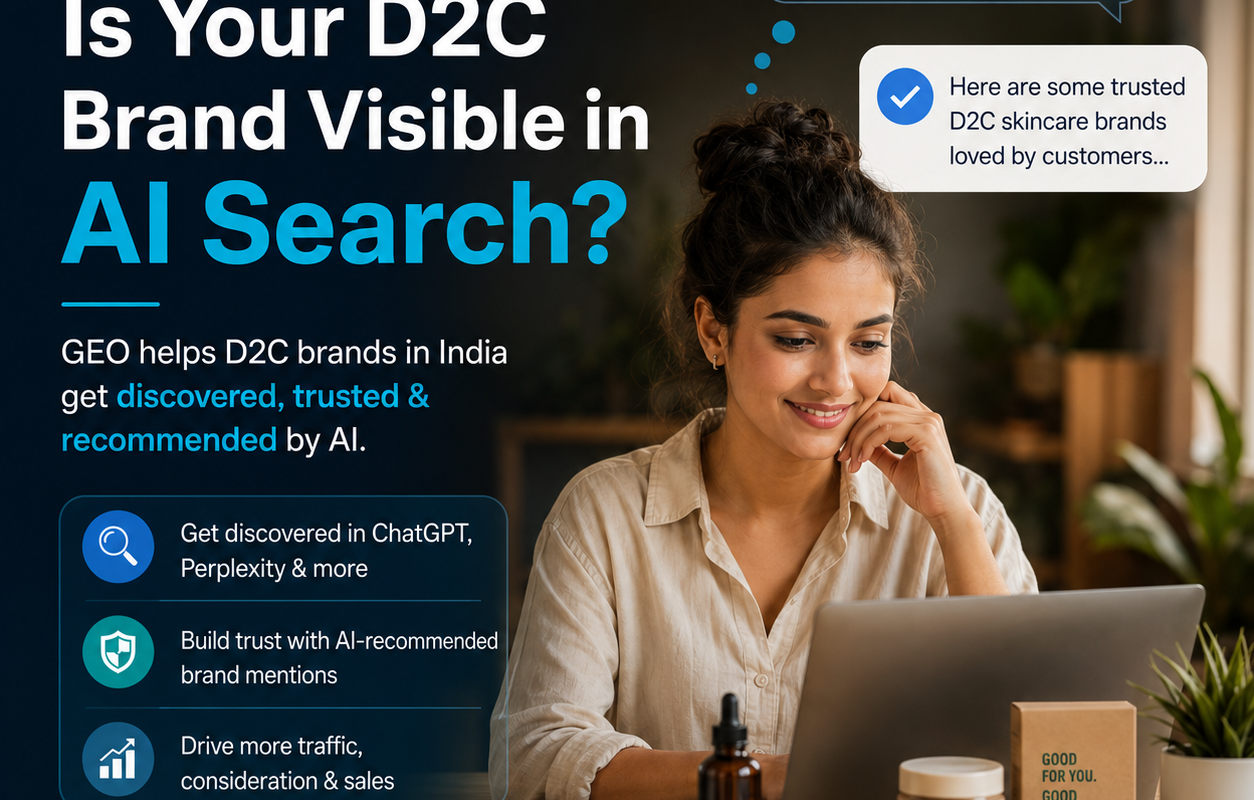
GEO D2C brands India ChatGPT is what this guide covers — practical, step-by-step advice for Indian brands building AI search visibility.
Indian D2C brands spend heavily on Instagram ads, Google Shopping, and influencer campaigns. Most have invested in SEO. But the buying journey has changed.
More and more Indian buyers — especially in the 25-40 age group — are starting their product discovery on ChatGPT or Perplexity before they visit a brand’s website. They are asking questions like:
- “Best D2C skincare brand India without chemicals”
- “Affordable lab grown diamond jewellery India”
- “Handcrafted leather bags Indian brand”
- “Best Indian D2C protein brand for women”
If your brand does not appear in the answer to these queries, a competitor does. And that AI-generated recommendation carries the weight of a trusted friend’s opinion — not an ad. It converts at 2-3x the rate of traditional search clicks.
This guide covers the four specific actions that get Indian D2C brands appearing on AI platforms.
GEO D2C brands India ChatGPT — Why D2C Brands Are Uniquely Well-Positioned for GEO
D2C brands have a structural GEO advantage that B2B companies do not: buyers ask highly specific, trust-based questions before purchasing — exactly the type of content AI is built to answer.
- “Is this product BIS certified?” → Product schema opportunity
- “What are the ingredients?” → AEO content opportunity
- “Can I return this if it doesn’t fit?” → FAQ schema opportunity
- “What are real customers saying?” → Review aggregation opportunity
- “Which size should I buy?” → Sizing guide as AEO content
Every one of these questions is a GEO signal you can activate. Brands that answer them in machine-readable formats get cited. Brands that bury them in PDFs or chat widgets do not.
4 Practical GEO Actions for Indian D2C Brands
Action 1 — Implement Product Schema on Every Listing
Product schema is the most important GEO action for any D2C brand. It tells AI systems — and Google — exactly what your product is, what it costs, whether it is in stock, and what customers think of it. Without it, AI platforms treat your product page as generic text.
Minimum required fields for every product:
- name — exact product name
- description — 100-200 words, include key attributes (material, size, use case)
- brand — your brand entity
- offers — price in INR, currency: INR, availability
- aggregateRating — star rating and review count
- image — high quality product image URL
- category — specific product category
- For jewellery add: material, gemstone, purity, hallmark status
- For food/supplements add: ingredients, dietary restrictions, certifications
- For fashion add: size guide, material, care instructions
On WooCommerce or Shopify, most schema plugins (RankMath for WooCommerce, Schema Pro) can generate this automatically if your product data is complete. The work is in filling in the data — the plugin handles the markup.
Action 2 — Build Entity Consistency Across All Selling Platforms
AI systems build confidence in a brand by seeing the same entity described consistently across multiple platforms. For a D2C brand this means:
- Your brand name must be identical everywhere — website, Amazon, Flipkart, Nykaa, Myntra, Instagram, Google Business
- Your brand description must say the same thing in the same language
- Your founding story, founder name, and key product claims must be consistent
- Your registered address must match across all platforms
The most common mistake: a brand calls itself “XYZ India” on its website, “XYZ Official” on Instagram, “XYZ Pvt Ltd” on Amazon, and “XYZ Shop” on Flipkart. To an AI system, these are four different entities. None of them builds enough authority to get cited.
Action 3 — Create AEO Content That Answers Buyer Questions
Add FAQ sections to every product page, every category page, and your homepage. The questions should be the actual questions your buyers ask before purchasing. You know these questions — they are in your customer WhatsApps, your Instagram DMs, and your customer service emails.
For a jewellery D2C brand, an FAQ section might include:
- Is this jewellery BIS hallmarked? (Yes, all our gold pieces carry BIS 916 hallmark)
- What is the purity of your gold? (We use 22 karat / 916 gold for all our pieces)
- Can I customise this piece? (Yes, customisation is available with a 15-day lead time)
- What is your return policy? (We offer 15-day returns on all unworn jewellery)
- Do you ship internationally? (We ship to 15 countries — see full list)
Add FAQPage schema to these questions. This is the direct bridge between your content and AI-generated answers on ChatGPT and Google AI Overviews.
Action 4 — Aggregate Reviews Across Platforms
AI systems use review volume and recency as trust signals. A D2C brand with 500 reviews spread across Amazon, Flipkart, Nykaa, and Google Business is significantly more citable than one with 500 reviews on its own website only.
What to do:
- Audit your review presence — where do you have reviews and how many?
- Create or claim your Google Business Profile and actively collect reviews there
- Add a post-purchase WhatsApp follow-up asking for a Google review (not Amazon — THEIR policy)
- Respond to every negative review publicly — this signals trust to AI systems
- Implement AggregateRating schema on your website to make your review count machine-readable
The GEO Audit for D2C Brands — Do This in 20 Minutes
Open ChatGPT, Perplexity, and Gemini. Run these queries with your category substituted:
- “Best [your category] D2C brand India”
- “Where to buy [your hero product] online India”
- “[your category] brand India without [common ingredient/chemical to avoid]”
- “Best Indian [your category] brand under [your price point]”
- “[your product type] gifting India”
Which brands appear? What do their product pages, schema, and review profiles look like compared to yours? The gap you see is the GEO gap. The four actions above close it.
Book a free 45-minute live GEO audit →
We run your category queries across ChatGPT, Perplexity, Gemini, Copilot, and Claude in real time.
About the author
Sushmita Sen Gupta is Co-Founder & CSO of Grow Smart with AI — India’s AI-powered digital marketing and GEO/AEO consultancy. AI Trailblazer 2025 (Government of India). 20+ years across IBM, Unilever, Rolls Royce, Bosch and Huawei through Ogilvy and Mather. Author of Everyday AI: A Minimal Practical Guide.
growsmartwithai.com · © 2026 Grow Smart with AI
How can an Indian D2C brand appear on ChatGPT and Perplexity?
Indian D2C brands appear on ChatGPT and Perplexity by implementing Product schema markup, building entity consistency across all selling platforms, creating AEO FAQ content answering buyer questions, and aggregating reviews across Amazon, Flipkart, and Google Business Profile.
What is Product schema and why does it matter for D2C?
Product schema tells AI systems exactly what your product is, its price, availability, ratings, and attributes. Without it, AI platforms treat your product page as generic text and rarely cite it in recommendations.
Why is entity consistency important for D2C brands?
AI systems build confidence by seeing the same brand described identically across website, Amazon, Flipkart, Instagram, and Google Business. Inconsistent naming splits authority across multiple perceived entities.
How do reviews affect AI citations for D2C?
AI systems use review volume and recency as trust signals. Reviews spread across Amazon, Flipkart, Nykaa, and Google Business carry more citation weight than the same number confined to your own website.
Can small D2C brands compete on ChatGPT without a big budget?
Yes. Product schema, FAQ content, entity consistency, and Google Business reviews are free. They level the playing field against larger brands that rely on paid ads but lack structured GEO signals.
More guides: Grow Smart with AI blog.
Further reading: Bing Webmaster Tools, Schema.org documentation, and Google structured data intro.
Practical note on GEO D2C brands India ChatGPT: Indian brands should document entities, publish corroborating pages, and measure LLM citations monthly.
Teams implementing GEO D2C brands India ChatGPT often combine schema markup, Bing Webmaster Tools, and AEO-formatted FAQs for faster AI visibility.
When you prioritise GEO D2C brands India ChatGPT, focus on clear definitions, expert authorship, and outbound references that models can verify.
Practical note on GEO D2C brands India ChatGPT: Indian brands should document entities, publish corroborating pages, and measure LLM citations monthly.
Teams implementing GEO D2C brands India ChatGPT often combine schema markup, Bing Webmaster Tools, and AEO-formatted FAQs for faster AI visibility.
When you prioritise GEO D2C brands India ChatGPT, focus on clear definitions, expert authorship, and outbound references that models can verify.
Practical note on GEO D2C brands India ChatGPT: Indian brands should document entities, publish corroborating pages, and measure LLM citations monthly.