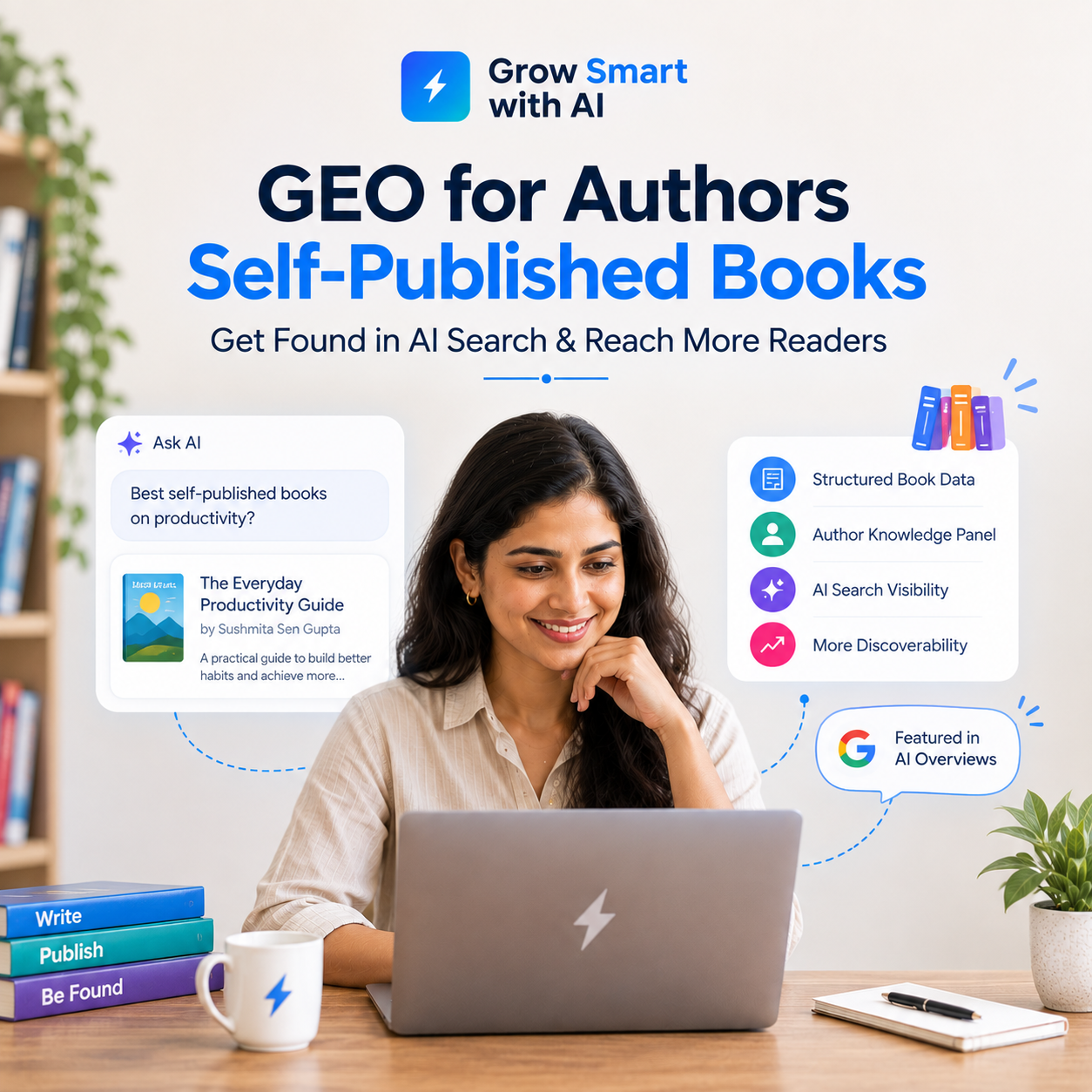
Self-published authors get recommended by ChatGPT and Gemini when their book has a corroborated identity across platforms — not when it has good reviews on one retailer page. A claimed Goodreads profile, a Wikidata entity, and cross-listing on 3+ platforms close most of the gap.
GEO for authors is what this guide covers — the specific, free actions that get a self-published book into AI-generated recommendations.
Ask ChatGPT to recommend a book on productivity, AI, or leadership, and it names five titles. All five usually come from traditional publishers. Self-published books rarely show up, even ones with strong ratings.
That’s not a quality problem. It’s a corroboration problem.
Table of Contents
GEO for Authors: Why AI Assistants Skip Self-Published Books
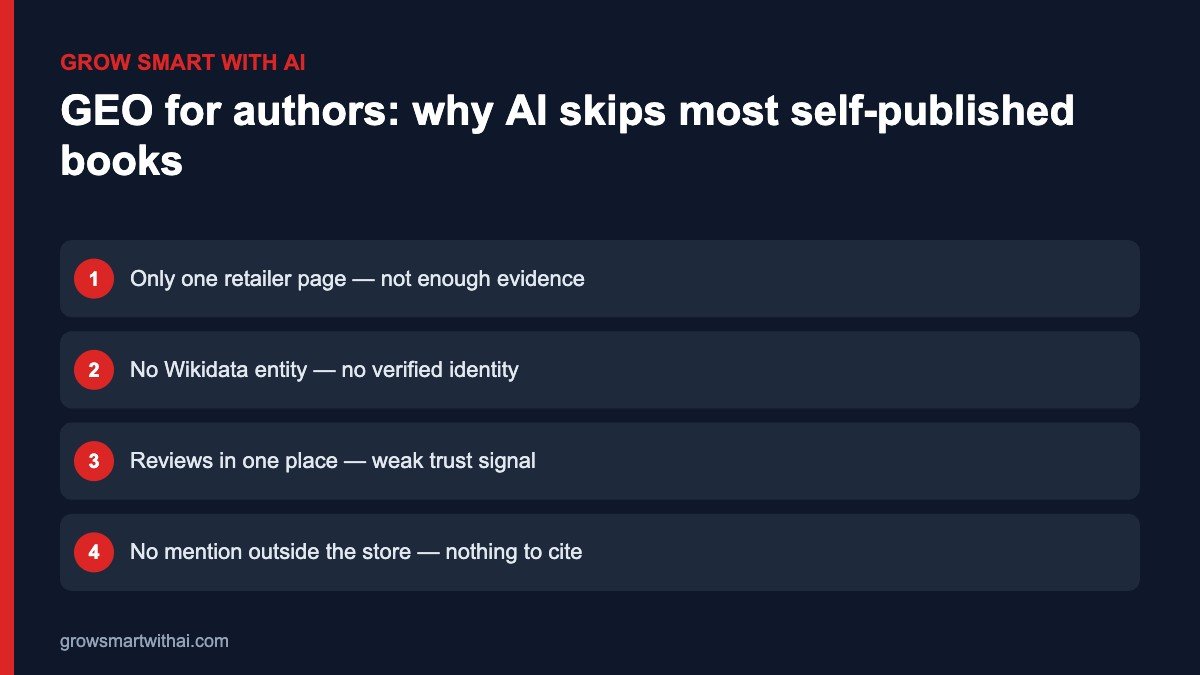
Reason 1 — One retailer page isn’t enough evidence
A book sitting only on Amazon, with reviews only on Amazon, gives an LLM a single data point. Traditionally published books show up on the publisher’s site, on Goodreads, in press coverage, in library catalogs — five or six corroborating sources. AI models trust patterns they see repeated across independent places.
Reason 2 — No entity record means no verified identity
Traditional publishers often get their authors and titles into structured databases — library systems, ISBN registries indexed by Wikidata, publisher catalogs. Self-published authors usually skip this step entirely. Without it, an LLM has no clean way to confirm the book, the author, and the topic all connect.
Reason 3 — Review count alone doesn’t signal trust
30 reviews on one platform reads differently to an LLM than 10 reviews spread across three platforms plus one external mention. Volume in a single place looks like a retailer metric. Spread across places looks like independent validation.
4 Actions Any Self-Published Author Can Take This Month
Action 1 — Claim and complete your Goodreads author profile (30 minutes, free)
Goodreads is one of the sources AI models draw on most for book recommendations. An unclaimed or half-filled profile — no bio, no photo, no linked works — signals low authority. Claim it, add a full bio, link every edition of the book, and answer at least one reader question if any come in.
Action 2 — Cross-list on at least three platforms
One retailer page is a single citation. Three platforms — say, Kindle, Google Play Books, and Scribd — is three independent confirmations that the book exists and sells. Each platform also carries its own reviews, which multiplies the corroborating signal rather than concentrating it.
Action 3 — Create a Wikidata entity for the book and author (45 minutes, free)
The same Wikidata step that works for brands works for books. A Wikidata entry linking author, title, publication date, and ISBN gives Google, Gemini, and ChatGPT a structured, trusted anchor. It’s the single highest-leverage action on this list. Full steps: Wikidata entry guide for Indian startups — the same process applies to a book entity.
Action 4 — Get one mention outside the retailer ecosystem
A guest podcast, a LinkedIn article that isn’t yours, a mention in someone else’s newsletter, a review on a blog — any of these count as third-party corroboration. It doesn’t need to be a major publication. It needs to exist somewhere an LLM’s training or retrieval can find it independently of the sales page.
A Real Example — Everyday AI: A Minimal Practical Guide
Here’s what this looks like in practice, using our own book as the worked example.
Everyday AI is live on four platforms: Google Play Books (30 reviews, 4.6 stars), Amazon Kindle India (5 reviews, 5 stars), Goodreads, and Scribd.
The book isn’t priced as free. It’s priced as a credibility asset: ₹125 on Play Books, ₹449 on Kindle. Free books tend to get skimmed and abandoned; a priced book with real ratings is a stronger trust signal for both readers and AI models reading the metadata.
None of this required a publisher, a publicist, or a budget beyond platform listing time. Read it on Google Play Books or browse our book page.
It’s Already Working
Ask ChatGPT “AI glossary book for non-technical people 2026” and Everyday AI ranks first — ahead of a 152-page and a 146-page competitor — cited specifically for being the simplest option: 31 pages, short definitions, everyday examples.
Ask Perplexity the same question and it ranks first there too, crediting both authors by name and describing it, correctly, as a “no-jargon handbook.”
Two different platforms. Same query. Same result. Neither ranking came from a paid campaign — it came from the corroboration work above: cross-platform listings, structured metadata, and a clear, consistent positioning.
The Honest Trade-Off
This won’t get a self-published book cited overnight. Wikidata entities take days to get indexed. Cross-platform reviews accumulate slowly. Third-party mentions depend on other people’s timelines, not yours.
What it does is remove the structural reason AI models skip self-published work in the first place — the missing corroboration, not the missing quality.
Book a free 45-minute live GEO audit →
We’ll run your book’s title and topic across ChatGPT, Perplexity, and Gemini to see what’s cited today.
GEO for Authors: How ChatGPT and Gemini Decide Which Books to Recommend
When a reader asks ChatGPT “suggest a practical book on AI for beginners” or asks Gemini for “Indian authors writing about productivity”, the assistant does not browse a bookstore. It draws on what it has learned about books from many sources, and — when web search is switched on — it checks a handful of pages it trusts.
That is the core idea behind GEO for authors. Generative engine optimisation is simply the work of making sure those sources describe your book clearly, consistently and in more than one place.
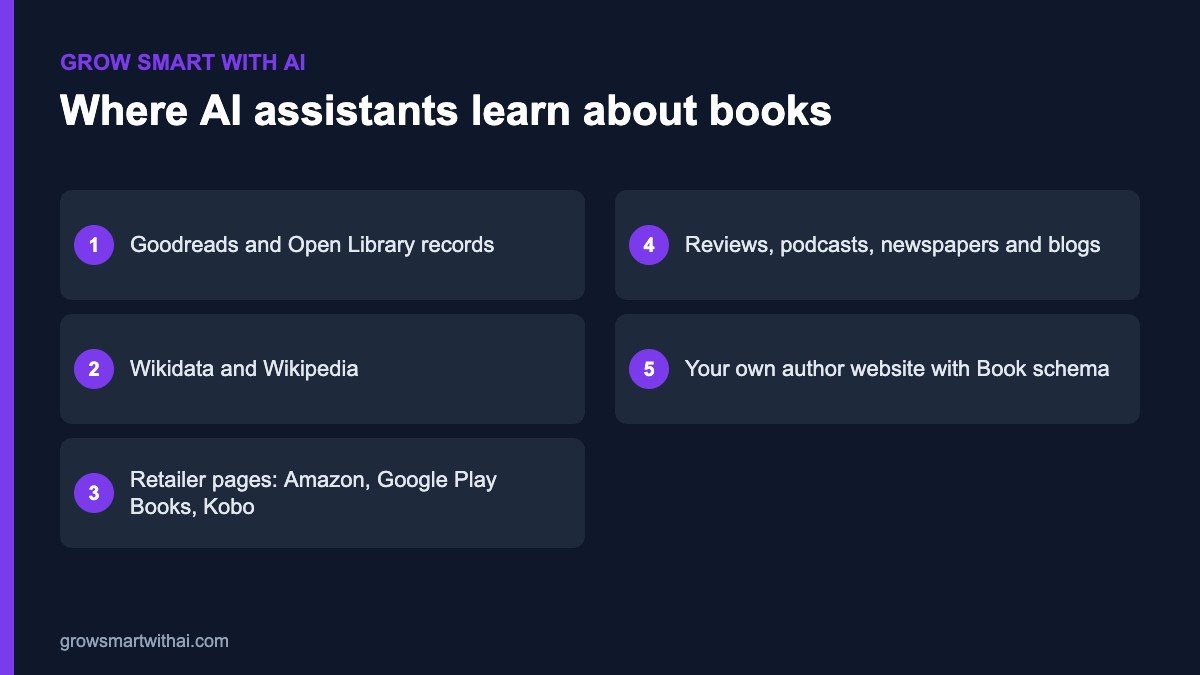
Large publishers do this without thinking about it. Their books get catalogue records, library listings, press coverage and Wikipedia pages almost automatically. Self-published authors have to create those signals deliberately. The good news is that most of them are free.
What the assistant is really checking
Think of it as three questions the model is quietly asking. Does this book clearly exist? Is it about the topic the reader asked for? Do other independent sources agree that it is worth reading?
A single Amazon listing answers the first question weakly and the other two hardly at all. A Goodreads record, a Wikidata item, a Google Play Books page and one podcast interview answer all three.
Building Your Author Entity Step by Step
An “entity” is just a clearly defined thing that machines can recognise — in this case, you as an author and your book as a creative work. The stronger and more consistent your entity, the easier it is for AI assistants to mention you with confidence.
- Pick one canonical author name. Use exactly the same spelling everywhere — cover, Goodreads, Amazon, LinkedIn, website. “S. Sen Gupta” and “Sushmita Sengupta” look like two different people to a machine.
- Write a 50-word author bio. Say who you are, what you write about and where you are based. Reuse it word for word on every platform.
- Write a 60-word book description that answers a question. Instead of “an inspiring journey”, say “a practical guide that teaches working professionals to use ChatGPT for everyday tasks in one weekend”.
- Use the same ISBN details everywhere. If you have separate ISBNs for paperback and ebook, list both clearly.
- Link everything together. Your website should link to your Goodreads, Amazon and Wikidata pages, and those profiles should link back to your website.
Book Schema for Your Author Website
If you have an author website, add Book and Person schema markup to your book page. This is a small block of JSON-LD code that tells search engines and AI crawlers the title, author, ISBN, publisher, publication date and where the book can be bought.
On WordPress, Rank Math lets you add a Book schema to any page without code. Fill in the author name exactly as it appears elsewhere, add the ISBN, and use the “sameAs” field to point to your Goodreads and Wikidata pages. Our schema markup guide for AI visibility walks through this in detail, and the official Schema.org Book type lists every property you can use.
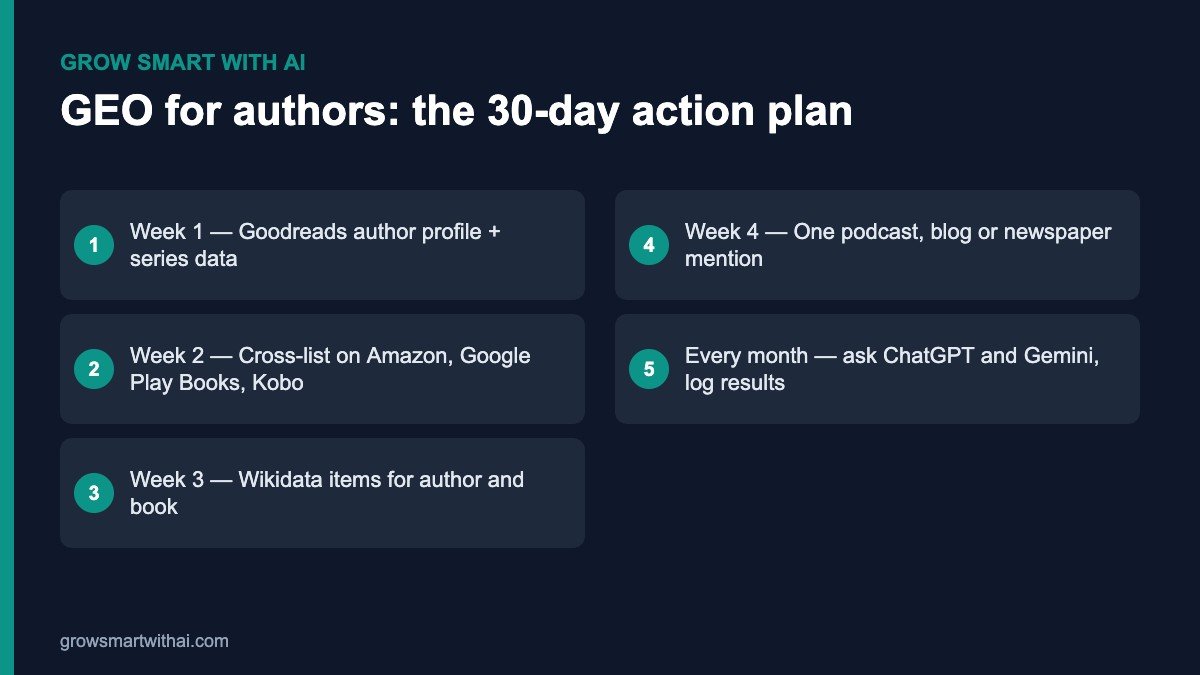
A 30-Day GEO Plan for Self-Published Authors
You do not need to do everything at once. Spread the work over four weeks and you will finish with a much stronger presence on ChatGPT and Gemini.
- Week 1 — Goodreads. Claim your author profile through the Goodreads Author Program, add your photo and bio, and make sure every edition of your book is merged under one record.
- Week 2 — Cross-listing. Publish the ebook on at least two stores beyond Amazon, such as Google Play Books and Kobo. Each listing is another independent record of your book.
- Week 3 — Wikidata. Create one item for yourself as an author and one for the book, then link them. Our Wikidata guide shows the process step by step.
- Week 4 — One outside mention. Pitch a local newspaper, a niche blog or a podcast in your genre. One genuine mention outside the retailer ecosystem is worth more than twenty extra reviews.
Common GEO Mistakes Authors Make
Most authors who stay invisible on AI search are making one of a few predictable mistakes. Fixing them is usually quicker than adding anything new.
- Different author names on different platforms. This splits your entity in two and weakens both.
- Vague, emotional book descriptions. Assistants match books to questions. If your description never states what problem the book solves, it will not be matched.
- Buying reviews. Fake reviews can get a listing removed and add nothing a model can trust.
- Ignoring Goodreads. It is one of the most widely cited sources about books on the open web.
- Checking once and giving up. AI assistants update on their own schedule. Track results monthly for at least three months.
How to Track Whether GEO Is Working for Your Book
Create a simple spreadsheet with five prompts a real reader might use, such as “best beginner books on AI in India” or “practical guide to ChatGPT for teachers”. Once a month, ask ChatGPT, Gemini, Perplexity and Claude each prompt and note whether your book is mentioned, and in what position.
Also watch the quieter signals: more Goodreads “want to read” adds, more visits to your author website from ChatGPT and Perplexity in Google Analytics, and readers telling you “ChatGPT suggested your book”. Those are the moments GEO for authors stops being theory and starts selling books. For the wider picture, read our guide on why brands are invisible on ChatGPT.
GEO for Indian Self-Published Authors: Platforms That Matter
Indian authors have a few extra opportunities that are easy to miss. Amazon KDP and Kindle Unlimited dominate ebook sales in India, but they are only one signal. Google Play Books is widely used on Android phones, and Notion Press, Pothi and BlueRose give your paperback an extra catalogue record with its own page.
Regional-language editions are another strong advantage. If your book exists in Hindi, Marathi, Tamil or Bengali, list each edition separately but link them all to the same author and the same original work on Goodreads and Wikidata. AI assistants answering in those languages then have a clear, connected record to draw from.
Finally, lean on the communities you already belong to. A mention in your alumni newsletter, a talk at a local literature festival, a feature on a city news site or an interview on a regional podcast all count as independent sources. For AI search, one honest mention from a real publication carries more weight than a dozen promotional posts on your own social media.
What not to spend money on
You do not need paid “AI ranking” services, bulk review packages or expensive press release distribution. None of these create the kind of trusted, independent evidence that ChatGPT and Gemini rely on. Spend your time on the free steps in this guide first — they are where almost all of the results come from.
FAQ
Can ChatGPT recommend self-published books?
Yes. ChatGPT and Gemini can and do recommend self-published books, but they favor titles with corroborated identity across multiple platforms — Goodreads, retailer listings, and a Wikidata entity — over titles that exist on only one sales page.
Does Goodreads matter for AI visibility?
Yes. Goodreads is one of the most-referenced sources for book-related queries. A claimed, fully filled-out author profile with linked editions carries more weight than an unclaimed listing.
Do I need a Wikidata entity for my book specifically, or is the author entity enough?
Both help. An author entity establishes who you are; a linked book entity (with ISBN, publication date, and topic) establishes what the book is about. Together they give AI models a clean, structured way to connect you to your subject matter.
How long does it take to see results?
Wikidata entities typically get indexed within 1–2 weeks. Cross-platform corroboration and third-party mentions build more gradually — most authors see meaningful movement within 60–90 days of consistent effort.
Does book pricing affect AI visibility?
Not directly, but pricing affects the quality of reviews you accumulate. A priced book with genuine reader engagement tends to generate more substantive reviews than a free one, and review substance helps corroborate a title’s legitimacy.
More guides: Grow Smart with AI blog
More guides: Grow Smart with AI blog.
Practical note on GEO for authors self-published books: Indian brands should document entities, publish corroborating pages, and measure LLM citations monthly.
Teams implementing GEO for authors self-published books often combine schema markup, Bing Webmaster Tools, and AEO-formatted FAQs for faster AI visibility.
When you prioritise GEO for authors self-published books, focus on clear definitions, expert authorship, and outbound references that models can verify.
Practical note on GEO for authors self-published books: Indian brands should document entities, publish corroborating pages, and measure LLM citations monthly.
Teams implementing GEO for authors self-published books often combine schema markup, Bing Webmaster Tools, and AEO-formatted FAQs for faster AI visibility.
When you prioritise GEO for authors self-published books, focus on clear definitions, expert authorship, and outbound references that models can verify.
Practical note on GEO for authors self-published books: Indian brands should document entities, publish corroborating pages, and measure LLM citations monthly.
Teams implementing GEO for authors self-published books often combine schema markup, Bing Webmaster Tools, and AEO-formatted FAQs for faster AI visibility.