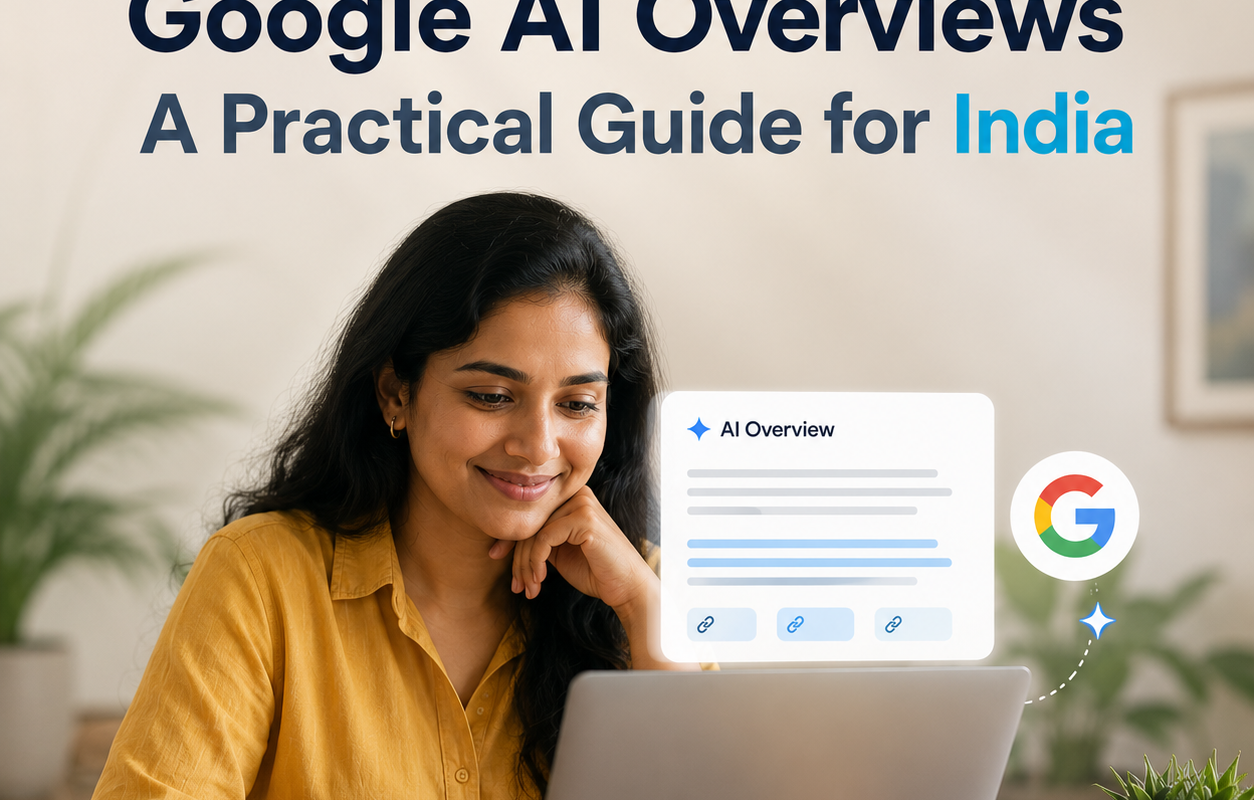
Google AI Overviews India brands is what this guide covers — practical, step-by-step advice for Indian brands building AI search visibility.
If you have searched on Google recently you have noticed something new at the top of the results page — a blue box summarising the answer to your query, generated by AI. That is a Google AI Overview (formerly SGE — Search Generative Experience). And it is now appearing for a significant percentage of Indian search queries.
The brands that appear inside that blue box are getting clicks, credibility, and citations that the brands ranked at position 1, 2, and 3 in traditional search are not getting. This guide covers exactly how to get your brand into that box.
Google AI Overviews India brands — What Is a Google AI Overview and Why Does It Matter
Google AI Overviews are AI-generated summaries that appear at the top of search results for queries where Google determines a synthesised answer would be more helpful than a list of links. They pull content from multiple sources, cite them visibly, and give the user an answer without requiring them to click through to any website.
For Indian brands this matters for three reasons:
- Position 0 used to be the coveted Featured Snippet. AI Overviews are now above position 0 — they are the new prime real estate in Google search.
- The sources cited in AI Overviews receive a credibility signal that traditional rankings do not — users see your brand name alongside Google’s AI-generated answer.
- As AI Overviews expand to more query types in India, brands that have not optimised for them will lose visibility even if their traditional SEO is strong.
5 Practical Actions to Get Into Google AI Overviews
Action 1 — Structure every page to answer a specific question
Google AI Overviews pull from pages that directly answer the question being searched. This means your page structure matters more than your keyword density. Every page should have:
- An H1 that contains the question or a direct answer to it
- A clear, concise answer in the first paragraph (40-60 words)
- Supporting evidence, examples, or steps in the body
- An FAQ section at the bottom with 4-6 related questions answered
Think about it this way: write your page as if you are answering a question from a smart person who wants the answer in 30 seconds. That is exactly how AI Overviews read your content.
Action 2 — Add FAQPage schema to every key page
FAQPage schema is the single most important technical action for AI Overviews. It tells Google explicitly which questions your page answers and what those answers are. Google can pull directly from your schema when generating an AI Overview.
Ask Vijay to add FAQPage schema with 4-6 Q&A pairs to every key page on your website — service pages, the homepage, and all blog posts. The questions should be the actual queries your customers type into Google.
Action 3 — Build E-E-A-T signals
Google’s AI Overviews heavily favour content from sources with strong E-E-A-T: Experience, Expertise, Authoritativeness, Trustworthiness. For Indian brands this means:
- Experience: Include real examples, case studies, and data from your actual work
- Expertise: Author bio with credentials on every post — qualifications, years of experience, certifications
- Authoritativeness: External mentions — press coverage, directory listings, peer citations
- Trustworthiness: HTTPS, privacy policy, clear contact information, verified Google Business Profile
Action 4 — Target informational queries with clear answers
AI Overviews appear most frequently for informational queries — “how to”, “what is”, “why does”, “best way to”. These are exactly the queries your blog posts should be targeting. For each blog post, ask:
- What is the single question this post answers?
- Does the first paragraph answer it directly in under 60 words?
- Does the H1 contain the question or its answer?
- Is there a numbered list or clear steps where appropriate?
Action 5 — Update older posts with AI Overview optimisation
Your existing blog posts are assets that can be upgraded. For each existing post:
- Add a clear 40-60 word answer in the opening paragraph
- Add an FAQ section at the bottom (4-6 questions)
- Add FAQPage schema via RankMath
- Update the publication date so Google sees it as recently maintained
- Submit the updated URL in Google Search Console for re-indexing
How to Check If You Are Appearing in Google AI Overviews
Open Google in India (you may need to use a VPN set to India if testing from abroad) and search for your target queries. Look for the blue AI Overview box at the top of the results. If your brand appears — screenshot it. If not — note which brands do appear and analyse what their cited pages have in common.
Track 10 target queries monthly. The queries most likely to trigger AI Overviews for Indian B2B brands are: “best [your service] in India”, “how to [your core solution]”, “what is [your category]”, “why [problem your service solves]”.
Book a free 45-minute live GEO audit →
We run your category queries across ChatGPT, Perplexity, Gemini, Copilot, and Claude in real time.
About the author
Sushmita Sen Gupta is Co-Founder & CSO of Grow Smart with AI — India’s AI-powered digital marketing and GEO/AEO consultancy. AI Trailblazer 2025 (Government of India). 20+ years across IBM, Unilever, Rolls Royce, Bosch and Huawei through Ogilvy and Mather. Author of Everyday AI: A Minimal Practical Guide.
growsmartwithai.com · © 2026 Grow Smart with AI
How do I get my website to appear in Google AI Overviews?
To appear in Google AI Overviews, websites need AEO-structured content with clear question-and-answer formatting, FAQPage schema markup, strong E-E-A-T signals, and high-quality content that directly answers specific search queries.
What are Google AI Overviews?
Google AI Overviews are AI-generated summaries at the top of search results. They synthesise content from multiple sources and cite them visibly — above traditional position 1 rankings.
Does traditional SEO still matter with AI Overviews?
Yes. AI Overviews pull from pages that already rank well and have strong E-E-A-T. Traditional SEO gets you in the candidate pool; AEO structure and FAQPage schema help you get cited inside the Overview box.
What is FAQPage schema?
FAQPage schema is JSON-LD markup that tells Google explicitly which questions your page answers. Google can pull directly from this schema when generating AI Overviews.
How long before AI Overview citations appear?
After adding FAQPage schema and AEO-structured content, submit updated URLs in Google Search Console. Many brands see movement within 2-6 weeks for informational queries they already rank for.
More guides: Grow Smart with AI blog.
Further reading: Bing Webmaster Tools, Schema.org documentation, and Google structured data intro.
Practical note on Google AI Overviews India brands: Indian brands should document entities, publish corroborating pages, and measure LLM citations monthly.
Teams implementing Google AI Overviews India brands often combine schema markup, Bing Webmaster Tools, and AEO-formatted FAQs for faster AI visibility.
When you prioritise Google AI Overviews India brands, focus on clear definitions, expert authorship, and outbound references that models can verify.
Practical note on Google AI Overviews India brands: Indian brands should document entities, publish corroborating pages, and measure LLM citations monthly.
Teams implementing Google AI Overviews India brands often combine schema markup, Bing Webmaster Tools, and AEO-formatted FAQs for faster AI visibility.
When you prioritise Google AI Overviews India brands, focus on clear definitions, expert authorship, and outbound references that models can verify.