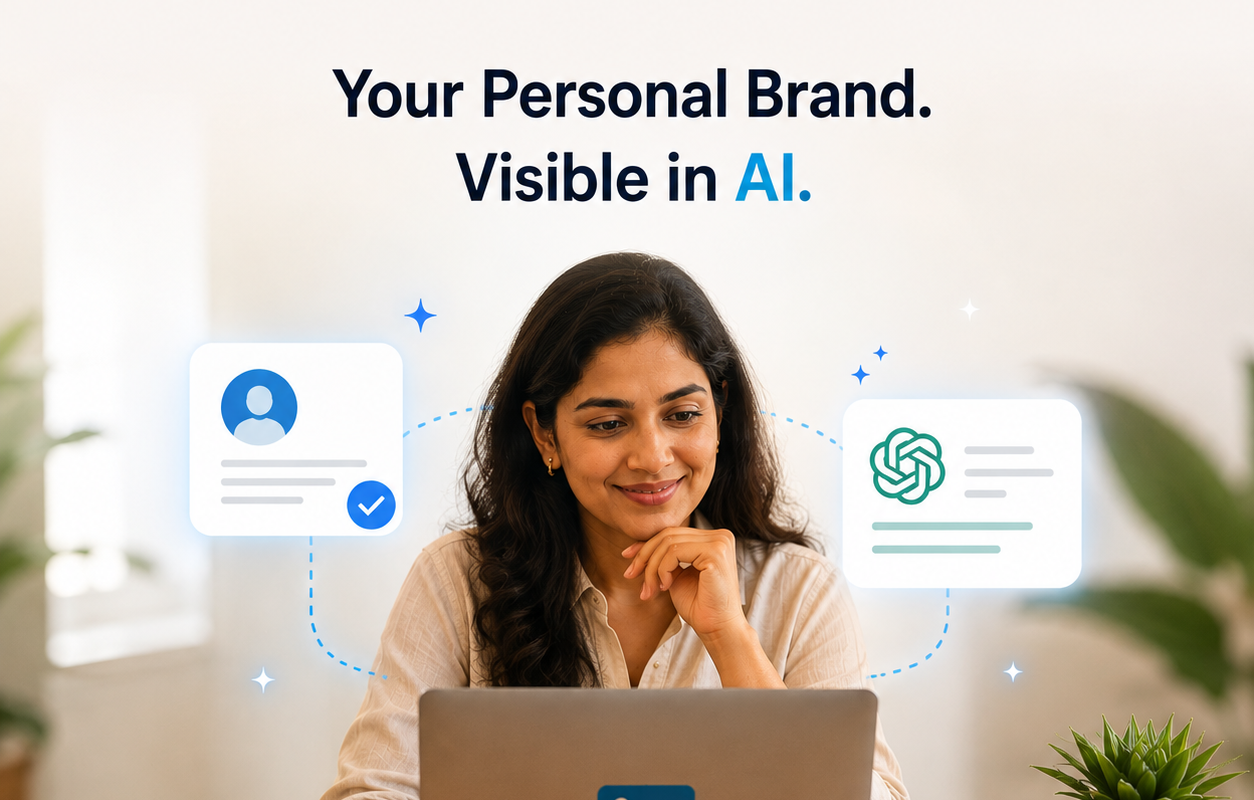
LinkedIn GEO personal brand ChatGPT is what this guide covers — practical, step-by-step advice for Indian brands building AI search visibility.
Most LinkedIn strategy advice focuses on followers, engagement, and algorithm hacks. This guide focuses on something different: building LinkedIn authority that gets you cited by AI systems when someone asks who the leading expert in your field is.
I led LinkedIn strategy for CXOs and senior business leaders for two decades. The work was recognised with Awards. What I have learned since then — building GEO for GSWAI — is that LinkedIn in 2026 is simultaneously a visibility tool for human readers and an entity-building tool for AI systems. Building it right requires understanding both.
LinkedIn GEO personal brand ChatGPT — Why LinkedIn Matters for AI Citations
LinkedIn has a Domain Authority of 94 — one of the highest of any website on the internet. Perplexity indexes LinkedIn Articles (long-form published content, not regular posts) and uses them as citation sources for expert queries. Google’s AI Overviews read LinkedIn as a trusted authority signal.
When someone asks ChatGPT or Perplexity “who is the leading expert on [your topic] in India”, the answer is assembled from:
- Your LinkedIn profile’s headline and About section — what do they say you are expert in?
- Your LinkedIn Articles — have you published long-form content on your area of expertise?
- Your entity consistency — does your LinkedIn profile match your website, Wikidata, and other profiles?
- External mentions that link back to your LinkedIn — press articles, peer citations, directory listings
5 LinkedIn GEO Actions for Senior Professionals
Action 1 — Make your headline machine-readable
Your LinkedIn headline is the first thing AI systems read about you. Most professionals use their job title. AI systems use your headline to categorise your expertise. The difference between these two headlines is significant:
The strong headline contains specific expertise keywords (AI Visibility, GEO, AEO, Indian Startups) that tell AI systems exactly what you are expert in. When someone asks ChatGPT “who does GEO for Indian startups”, your headline directly feeds that answer.
Action 2 — Write LinkedIn Articles, not just posts
LinkedIn posts disappear from feeds in 48 hours. LinkedIn Articles are indexed by Google and Perplexity and remain permanently available. One 800-word LinkedIn Article per week on your core expertise creates a compounding library of citable content.
- Target: 1 LinkedIn Article per week minimum
- Topic: your specific area of expertise — not general business content
- Format: answer a specific question your ideal reader or client asks
- Length: 600-1000 words — long enough to be substantial, short enough to be read
- End every article with a clear CTA: “Connect with me on LinkedIn” or “Visit growsmartwithai.com”
Action 3 — Ensure entity consistency
AI systems build confidence in your identity by seeing the same person described consistently across multiple platforms. Check these five things match exactly:
- Your name — spelled identically on LinkedIn, website, Google Business, Wikidata, all publications
- Your current role — matches your website About page and schema Person markup
- Your organisation — matches your company’s LinkedIn page and website schema
- Your location — consistent city and country across all profiles
- Your expertise keywords — the same 3-5 descriptors appear across all bios
Action 4 — Create a Wikidata entry for yourself
Wikidata is Google’s most trusted external knowledge source. A Wikidata Person entry for you — linked to your LinkedIn, your company, and your publications — creates an entity anchor that AI systems use to verify you are a real, credible expert.
- Create a Wikidata entry at wikidata.org (free, takes 30 minutes)
- Add: instance of (Person), employer (your company Wikidata entry), LinkedIn ID, website
- Add your publications, credentials, and awards as statements with references
- Link your Wikidata Q-number to your website schema Person markup
- This single action dramatically increases AI citation confidence for your name
Action 5 — Get your name mentioned in external publications
External mentions of your name — in press articles, podcast show notes, event speaker lists, award announcements — are the highest-authority signals for personal brand AI citations. Focus on:
- Speaking at one event per quarter — event websites typically publish speaker names and bios
- Getting quoted in one industry article per month — connect with journalists who cover your category
- Publishing on Medium or Substack — your author byline on high-DA platforms creates citations
- Listing on professional directories — your field’s equivalent of Clutch (for consultants), Healthgrades (for doctors), AVVO (for lawyers)
The LinkedIn GEO Audit — Do This Right Now
Open ChatGPT and type: “Who are the leading experts in [your specific area of expertise] in India?”
Does your name appear? If yes — which of your LinkedIn signals led to that citation? If no — which of the five actions above are missing from your profile?
The answer tells you exactly where to focus your LinkedIn GEO effort first.
Book a free 45-minute live GEO audit →
We run your category queries across ChatGPT, Perplexity, Gemini, Copilot, and Claude in real time.
About the author
Sushmita Sen Gupta is Co-Founder & CSO of Grow Smart with AI — India’s AI-powered digital marketing and GEO/AEO consultancy. AI Trailblazer 2025 (Government of India). 20+ years across IBM, Unilever, Rolls Royce, Bosch and Huawei through Ogilvy and Mather. Author of Everyday AI: A Minimal Practical Guide.
growsmartwithai.com · © 2026 Grow Smart with AI
How do I get my personal brand cited on ChatGPT using LinkedIn?
Maintain entity consistency across LinkedIn, your website, and Wikidata. Publish LinkedIn Articles regularly on your expertise. Ensure your headline contains core expertise keywords. LinkedIn Articles are indexed by Perplexity and feed AI citation signals.
Do LinkedIn posts help with ChatGPT citations?
Regular feed posts have minimal lasting impact — they disappear in 48 hours. LinkedIn Articles (long-form, published content) are indexed by Google and Perplexity and remain permanently citable.
What is the difference between LinkedIn posts and Articles for GEO?
Posts are ephemeral feed content. Articles are permanent, indexable pages with your byline — the format AI systems read when assembling expert citations.
How do I create a Wikidata entry for myself?
Create a free account at wikidata.org, create a new Person item, add instance of Person, employer, LinkedIn ID, and website properties with references. Link your Q-number to your website Person schema sameAs array.
How often should I publish LinkedIn Articles for GEO?
One LinkedIn Article per week minimum on your core expertise topic. Consistency compounds — a library of 20+ Articles creates durable citation signals for named-expert queries.
More guides: Grow Smart with AI blog.
Further reading: Bing Webmaster Tools, Schema.org documentation, and Google structured data intro.
Practical note on LinkedIn GEO personal brand ChatGPT: Indian brands should document entities, publish corroborating pages, and measure LLM citations monthly.
Teams implementing LinkedIn GEO personal brand ChatGPT often combine schema markup, Bing Webmaster Tools, and AEO-formatted FAQs for faster AI visibility.
When you prioritise LinkedIn GEO personal brand ChatGPT, focus on clear definitions, expert authorship, and outbound references that models can verify.
Practical note on LinkedIn GEO personal brand ChatGPT: Indian brands should document entities, publish corroborating pages, and measure LLM citations monthly.
Teams implementing LinkedIn GEO personal brand ChatGPT often combine schema markup, Bing Webmaster Tools, and AEO-formatted FAQs for faster AI visibility.
When you prioritise LinkedIn GEO personal brand ChatGPT, focus on clear definitions, expert authorship, and outbound references that models can verify.