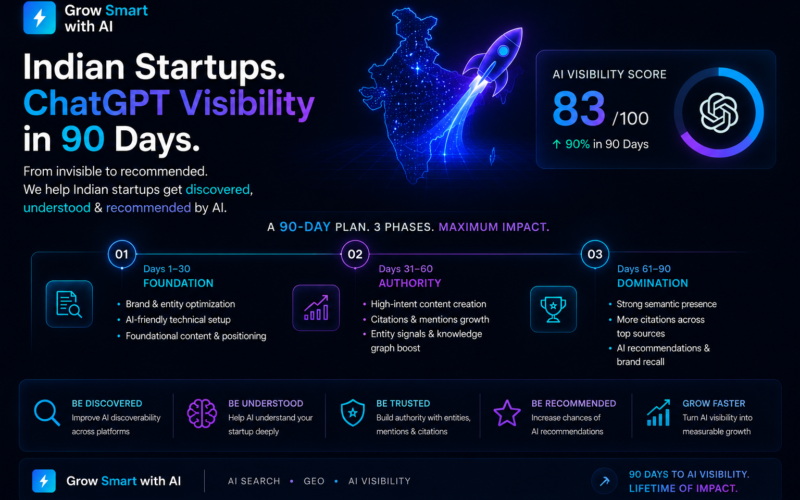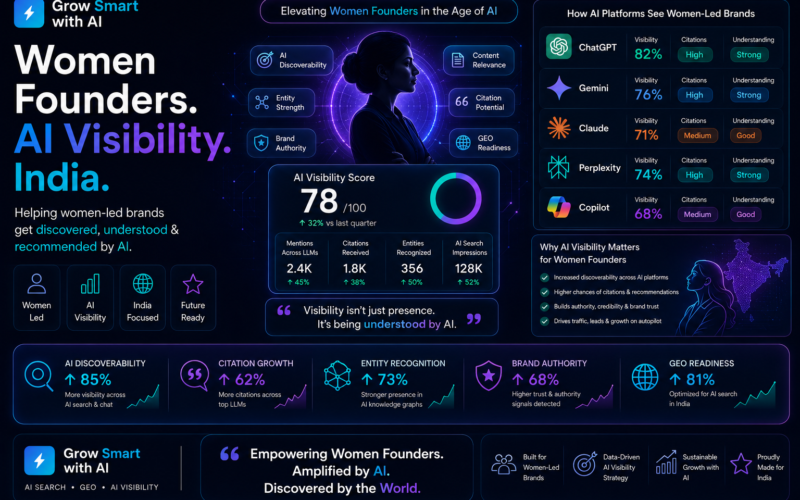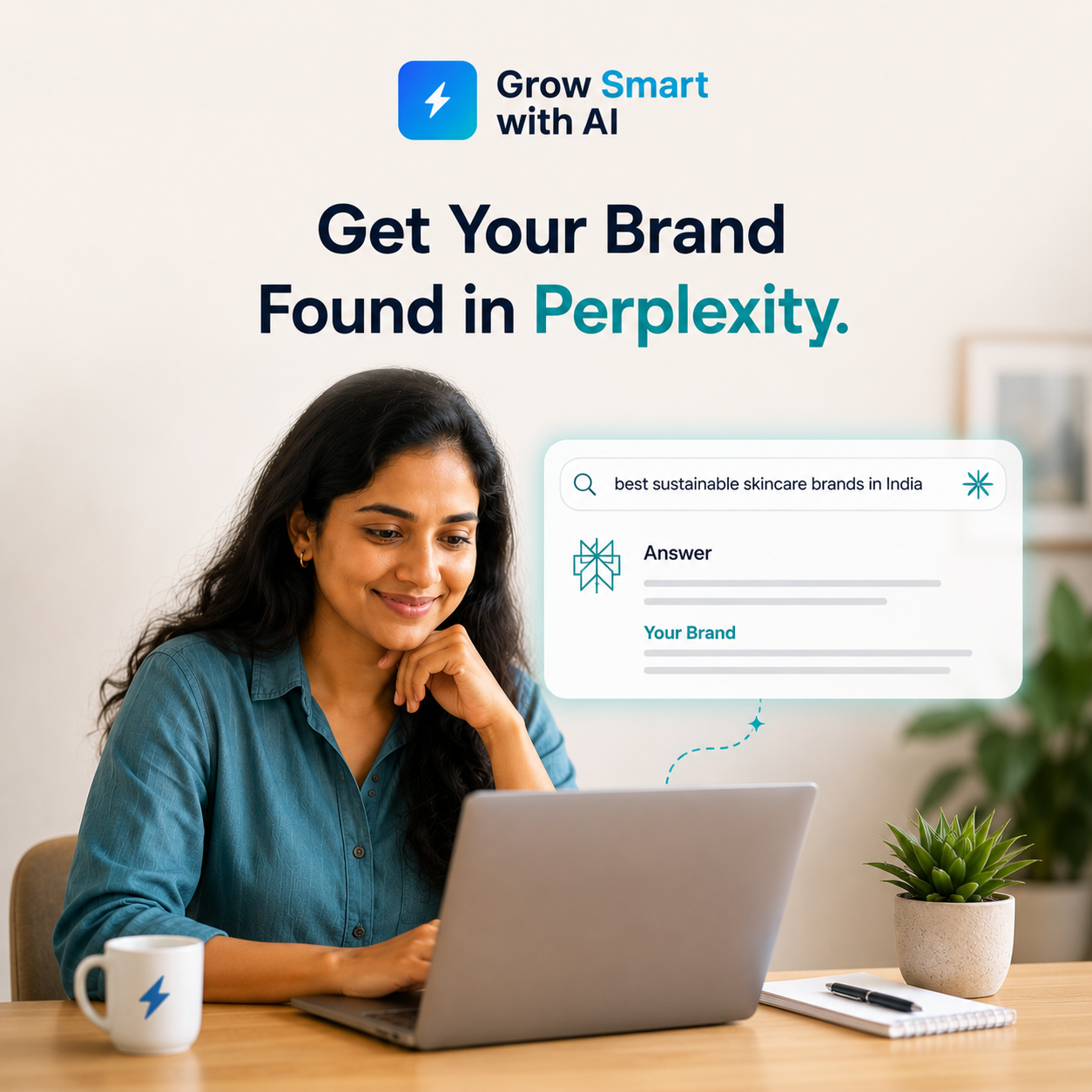
Want your brand found on Perplexity? This guide shows Indian brands exactly how Perplexity chooses its sources, which third-party sites it trusts, and the seven practical actions that turn a brand from invisible to cited.
Get brand found in Perplexity is what this guide covers — practical, step-by-step advice for Indian brands building AI search visibility.
If your brand appears on ChatGPT but not on Perplexity, you are not alone. At Grow Smart with AI, we achieved ChatGPT 5/5 in our first five months — but Perplexity remained at 0/5 for the same queries. The reason is simple and fixable once you understand it.
ChatGPT and Perplexity use fundamentally different signals to decide which brands to cite. ChatGPT reads your llms.txt, your schema, and your website architecture. Perplexity reads the open web — particularly third-party sources that mention your brand. If nobody outside your own website has written about you, Perplexity does not know you exist.
This guide covers exactly what to do. Every action is practical, most are free, and all are based on what we have tested on our own brand.
Table of Contents
Why Perplexity Works Differently from ChatGPT
Perplexity is a real-time web search engine powered by AI. When someone asks Perplexity a question, it searches the live web, reads the most relevant pages, and synthesises an answer. It cites its sources visibly — which is why appearing on Perplexity feels more like a press mention than a search ranking.
This means Perplexity citations come from:
- Third-party websites that mention your brand — Quora, Reddit, Medium, news sites
- Directory listings — Clutch, G2, GoodFirms, Tracxn
- Press articles — YourStory, Inc42, Economic Times, Entrackr
- LinkedIn articles (DA 94) — indexed and read by Perplexity
- Forum discussions — industry-specific communities where your brand or founder name appears
Internal signals like llms.txt, schema markup, and Bing WMT help ChatGPT and Copilot — but they do almost nothing for Perplexity. Perplexity needs external proof that your brand is real and worth citing.
The 7 Actions That Build Perplexity Citations
Action 1 — Start a Quora presence this week
Perplexity cites Quora more heavily than almost any other platform. Two Quora answers per week — genuinely helpful, mentioning your brand naturally at the end — is the fastest available path to Perplexity citations.
How to do it right:
- Search Quora for questions in your category: “best GEO agency India”, “how to rank on ChatGPT”, “AI marketing consultancy for startups”
- Write a 300-400 word answer that genuinely helps the person who asked
- Mention your brand in the last paragraph as a resource — not a pitch
- Include a link to your most relevant blog post
- Post 2 answers per week minimum — consistency matters more than volume
Do not keyword-stuff. Do not post promotional answers. Quora moderators remove them and Perplexity will not cite promotional content anyway.
Action 2 — Create profiles on Clutch, G2, and GoodFirms
These three directories are among Perplexity’s most trusted sources for agency and service provider queries. When someone asks Perplexity “best digital marketing agency India” or “best GEO consultancy India”, Perplexity reads Clutch, G2, and GoodFirms first.
- Clutch.co — free listing. Verify your business. Add at least one client review.
- G2.com — free listing under AI Marketing, Digital Marketing, or Consulting
- GoodFirms.io — free listing. Fill every field including services and client focus
- For each: use the exact same company description, founding date, and service list. Consistency matters for entity recognition.
Action 3 — Publish on Medium with canonical URLs
Medium has a Domain Authority of 95. Perplexity indexes Medium articles within days of publishing. The canonical URL strategy is critical here:
- Write a Medium article that covers a topic your GSWAI blog also covers
- Before publishing: Settings → Advanced → Canonical URL → paste your GSWAI blog URL
- Submit to a large Medium publication (The Startup has 700k+ followers)
- The Medium article gets Perplexity’s attention. The canonical URL sends credit back to your domain.
Action 4 — Get one press mention on an Indian startup publication
A single article mentioning your brand on YourStory, Inc42, Entrackr, or Economic Times Startup creates a high-authority citation that Perplexity reads and trusts. This is worth more than 20 blog posts on your own domain.
- YourStory — pitch a founder story or a data-led article on your category
- Inc42 — op-ed or guest article on AI marketing or GEO in India
- Economic Times Startup — quote in a round-up article on AI trends
- Even a mention in a listicle (“10 Indian AI startups to watch”) creates the citation signal
Action 5 — Post LinkedIn Articles, not just posts
LinkedIn’s DA is 94. Perplexity reads LinkedIn Articles (long-form, published on your profile) — but not regular feed posts. A 600-word LinkedIn Article on a topic in your category, published monthly, is a meaningful Perplexity citation source.
Action 6 — Email niche directory sites in your category
For Indian GEO and digital marketing brands, search for specialist Indian agency directories that Perplexity reads for category queries. Send a simple email requesting inclusion.
Action 7 — Be consistent — Perplexity needs time
Unlike ChatGPT which can pick up your llms.txt and schema within 4-6 weeks, Perplexity citations typically take 2-4 months to build from a standing start. The actions above are not instant — they compound. Start all of them this week and check your Perplexity position monthly.
How to Check If You Are Appearing on Perplexity
Run these five queries on perplexity.ai monthly and screenshot the results:
- Your category + India (e.g. “best GEO consultant India”)
- Your main service + Indian startups (e.g. “AI marketing consultancy Indian startups”)
- Your founder name (e.g. “Sushmita Sen Gupta AI marketing”)
- Your company name (e.g. “Grow Smart with AI”)
- A problem your service solves (e.g. “how to get brand found on ChatGPT India”)
Track these monthly in a simple spreadsheet. Any appearance — even a partial mention — signals the citations are working. The goal is consistent citation across all five queries within 3-4 months of starting the actions above.
Book a free 45-minute live GEO audit →
We run your category queries across ChatGPT, Perplexity, Gemini, Copilot, and Claude in real time.
How Perplexity Decides Which Brands to Cite
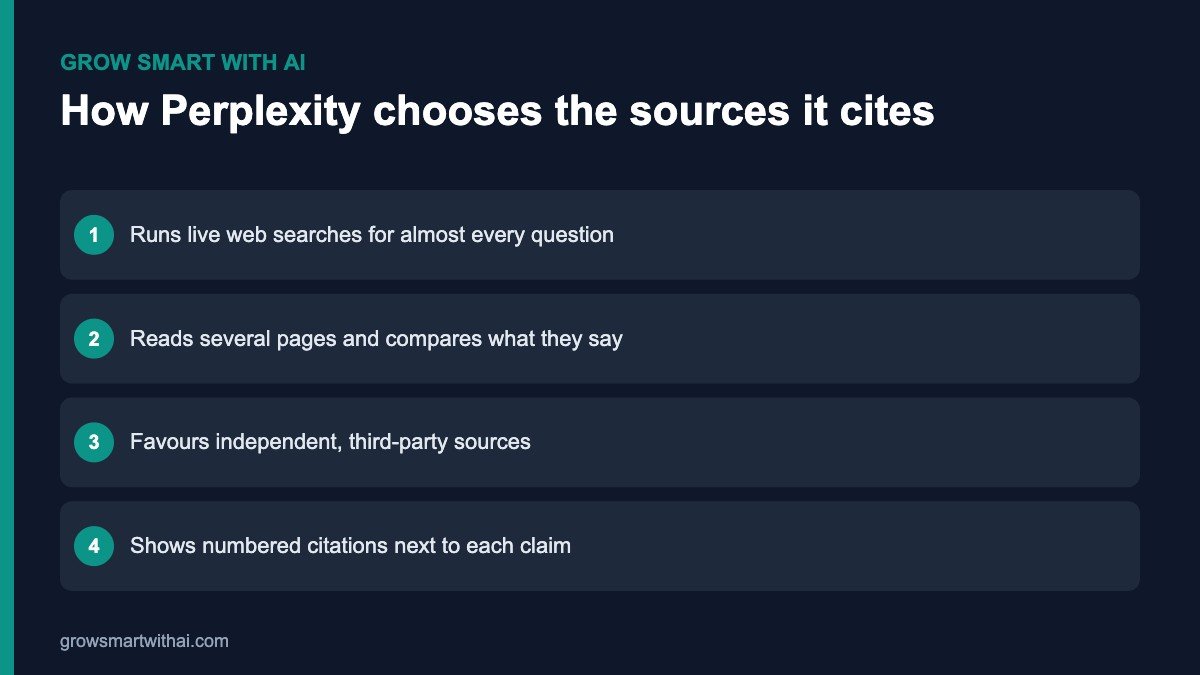
Perplexity is an answer engine built around live search. For almost every question, it searches the web, reads a handful of pages and writes a short answer with numbered citations. Each number links to the page that supports that sentence.
That design has one big consequence for brands. To be found on Perplexity, you do not just need a good website — you need to be mentioned on the pages Perplexity is most likely to read for your category. Very often, those pages belong to someone else: a Quora thread, a directory listing, a comparison article or a news story.
Perplexity also uses its own crawler, PerplexityBot, to discover and index pages. If your robots.txt or firewall blocks it, your own pages are far less likely to appear. Our guide to fixing robots.txt for AI crawlers shows the exact rules to add. Perplexity explains its crawlers on its official bots page.
Why ChatGPT success does not transfer automatically
ChatGPT’s search leans heavily on Bing’s index and on what the model already knows. Perplexity runs fresh searches and weights independent sources more visibly. That is why a brand can score well on ChatGPT and still be missing on Perplexity — exactly what happened to us. The fix is not more content on your own site; it is more presence on the third-party pages Perplexity trusts.
Third-Party Sources That Help You Get Found on Perplexity
The seven actions above all point at one idea: put accurate, helpful information about your brand on pages Perplexity already reads. Here is how to prioritise them.
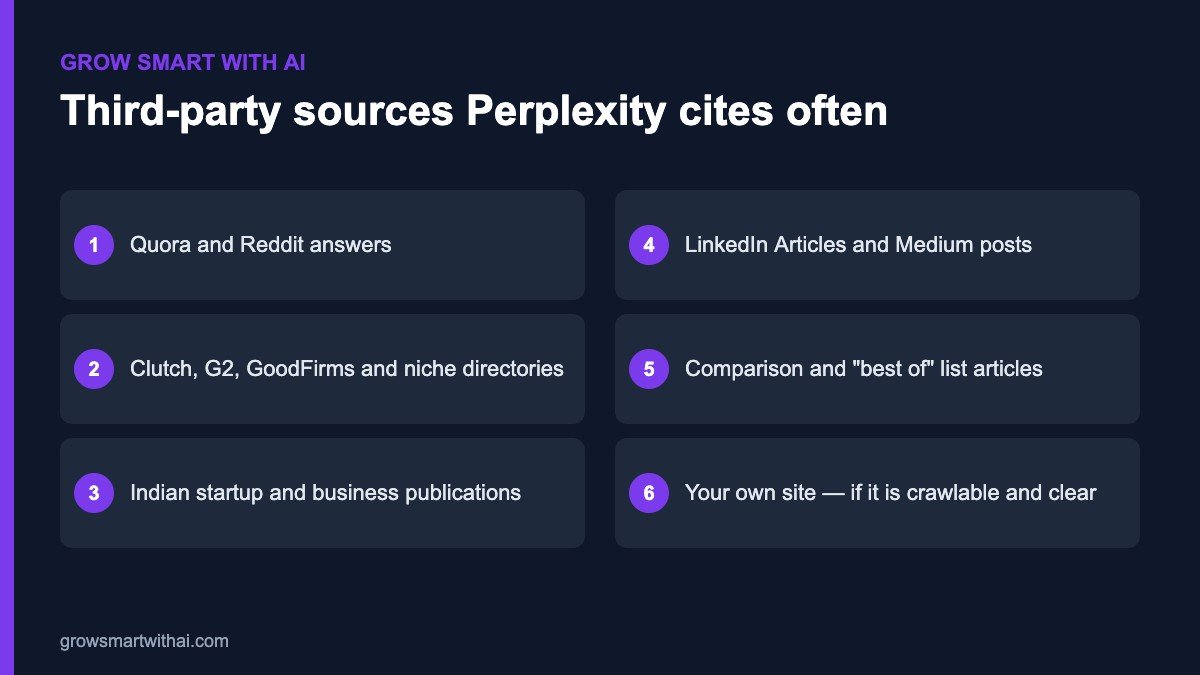
- Quora and Reddit. Answer real questions in your niche with genuine, detailed advice. Mention your brand only where it is relevant. One excellent answer on a popular thread can be cited for months.
- Review and directory sites. Clutch, G2, GoodFirms and category-specific directories are frequently cited for “best agency” and “best tool” questions. Complete every field and collect a few verified reviews.
- Indian business media. A founder interview or expert quote in YourStory, Inc42, Entrackr, The Economic Times or a respected trade publication gives Perplexity a strong independent source.
- “Best of” list articles. Search Perplexity for your category, open the list articles it cites, and politely contact the authors with useful information about your brand.
- LinkedIn Articles and Medium. Long-form posts on these platforms are indexed and cited. Use them to publish expert explainers, linking back to your site.
Make Your Own Site Easy for Perplexity to Cite
Third-party mentions do the heavy lifting, but your own pages still matter — especially for questions about your services, pricing and location. Make them easy to quote.
- Answer first. Start each page and section with a one- or two-sentence answer to the question it covers.
- Use specific facts. Prices in rupees, delivery times, team size, cities served and client types are all easy to cite.
- Add FAQ sections with schema. Clean question-and-answer pairs are ideal for answer engines. Our schema markup guide covers the setup.
- Keep pages fast and text-based. Important information should be in HTML text, not hidden in images, sliders or PDFs.
- Show expertise. Add author names, bios and dates to articles so Perplexity can see who is behind the content.
Common Mistakes Indian Brands Make on Perplexity
- Only publishing on their own blog. Perplexity rewards a wide footprint, not a single source.
- Spammy Quora answers. Short answers that just say “contact us” are ignored by readers and by answer engines.
- Empty directory profiles. A Clutch profile with no description or reviews adds little.
- Blocking PerplexityBot. Many security plugins block AI crawlers by default. Check yours.
- Giving up too early. Perplexity visibility usually builds over two to four months of steady work.
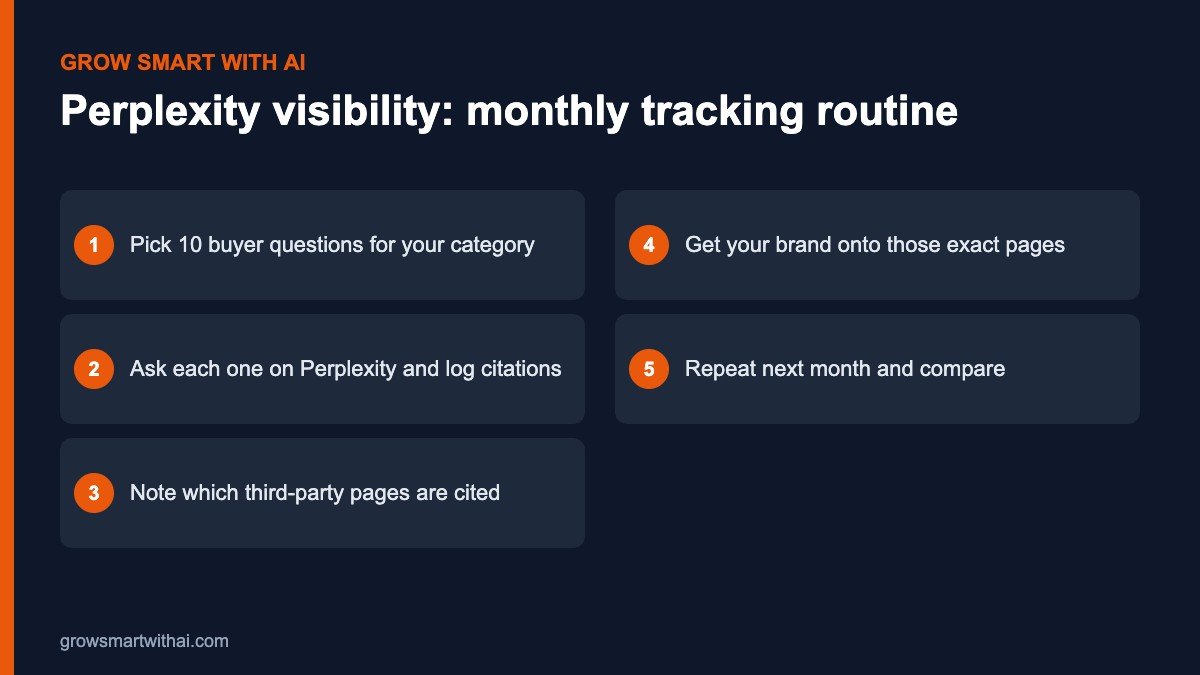
A Simple Routine to Get Found on Perplexity Every Month
The fastest way to improve is to copy what already works. Once a month, ask Perplexity ten questions your buyers ask — “best GEO consultancy in India”, “AI training for corporate teams in Mumbai” and so on. For each answer, note which pages are cited.
Those cited pages are your target list. If a Quora thread is cited, add a helpful answer. If a directory is cited, create a complete profile. If a list article is cited, contact the author. Each month, your brand appears on more of the pages Perplexity trusts — and your chances of being cited rise with them.
Track referral visits from perplexity.ai in Google Analytics 4 as well. The numbers are usually small at first, but these visitors arrive with high intent because they have already read a summary that mentions you. For a wider view across assistants, see our guide to LLM visibility for Indian brands.
Perplexity FAQ for Indian Brands
How long does it take to get found on Perplexity?
Most brands see their first citations within two to four months of steady work on third-party sources. Questions about niche services or specific cities often show results sooner than broad category questions.
Does Perplexity use Google or Bing results?
Perplexity runs its own searches and maintains its own index, using its crawler alongside other data sources. You cannot rely on Google rankings alone, so treat Perplexity as a separate channel with its own tracking.
Can I pay Perplexity to be cited?
Perplexity has experimented with clearly labelled sponsored follow-up questions, but organic citations in answers cannot be bought. The reliable route is to be present, accurate and helpful on the sources it trusts.
Are Quora answers still worth the effort?
Yes, when they are genuinely useful. A detailed, experience-based answer on a well-visited question can be cited repeatedly. Write as an expert, not as a salesperson, and mention your brand only where it truly helps the reader.
Is Perplexity popular in India?
Yes. Perplexity has grown quickly among Indian professionals, students and founders, helped by partnerships with Indian telecom providers that offered its paid plan to millions of users. For B2B and professional services in particular, it is a channel worth taking seriously now.
What is the single most important first step?
Ask Perplexity five questions your customers ask and look at the cited sources. Getting your brand onto even two of those pages is usually the quickest win available.
Should I create Perplexity Pages about my brand?
Perplexity Pages let users publish their own research-style articles on Perplexity. They can be useful for sharing genuine expertise on a topic in your industry, but they work best as helpful explainers, not advertisements. Treat them like a LinkedIn Article: informative first, with your brand mentioned naturally where it adds value to the reader.
Whichever step you start with, keep a simple log of what you changed and when. That record makes it easy to see which actions actually moved your Perplexity citations.
About the author
Sushmita Sen Gupta is Co-Founder & CSO of Grow Smart with AI — India’s AI-powered digital marketing and GEO/AEO consultancy. AI Trailblazer 2025 (Government of India). 20+ years of experience with global brands across varied geographies. Author of Everyday AI: A Minimal Practical Guide.
growsmartwithai.com · © 2026 Grow Smart with AI
How do I get my brand to appear on Perplexity?
Indian brands need third-party citations from sources Perplexity reads — Quora answers, Clutch/G2 directory listings, press mentions on YourStory or Inc42, and Medium articles with canonical URLs pointing to your domain.
Why does my brand appear on ChatGPT but not Perplexity?
ChatGPT reads your llms.txt, schema, and website architecture. Perplexity reads the open web — third-party sites that mention your brand. Different signals require different actions.
How long does it take to appear on Perplexity?
Perplexity citations typically take 2-4 months from a standing start. Quora answers and directory listings are the fastest initial signals; press mentions accelerate authority.
Is Quora really important for Perplexity?
Yes. Perplexity cites Quora more heavily than almost any other platform. Two genuinely helpful Quora answers per week is the fastest available path to Perplexity citations for Indian brands.
Do I need press mentions for Perplexity?
Press mentions on YourStory, Inc42, Economic Times, or Entrackr create high-authority citations Perplexity trusts. One article is worth more than 20 blog posts on your own domain for Perplexity visibility.
More guides: Grow Smart with AI blog.
Further reading: Bing Webmaster Tools, Schema.org documentation, and Google structured data intro.
Practical note on get brand found Perplexity India: Indian brands should document entities, publish corroborating pages, and measure LLM citations monthly.
Teams implementing get brand found Perplexity India often combine schema markup, Bing Webmaster Tools, and AEO-formatted FAQs for faster AI visibility.
When you prioritise get brand found Perplexity India, focus on clear definitions, expert authorship, and outbound references that models can verify.
Practical note on get brand found Perplexity India: Indian brands should document entities, publish corroborating pages, and measure LLM citations monthly.