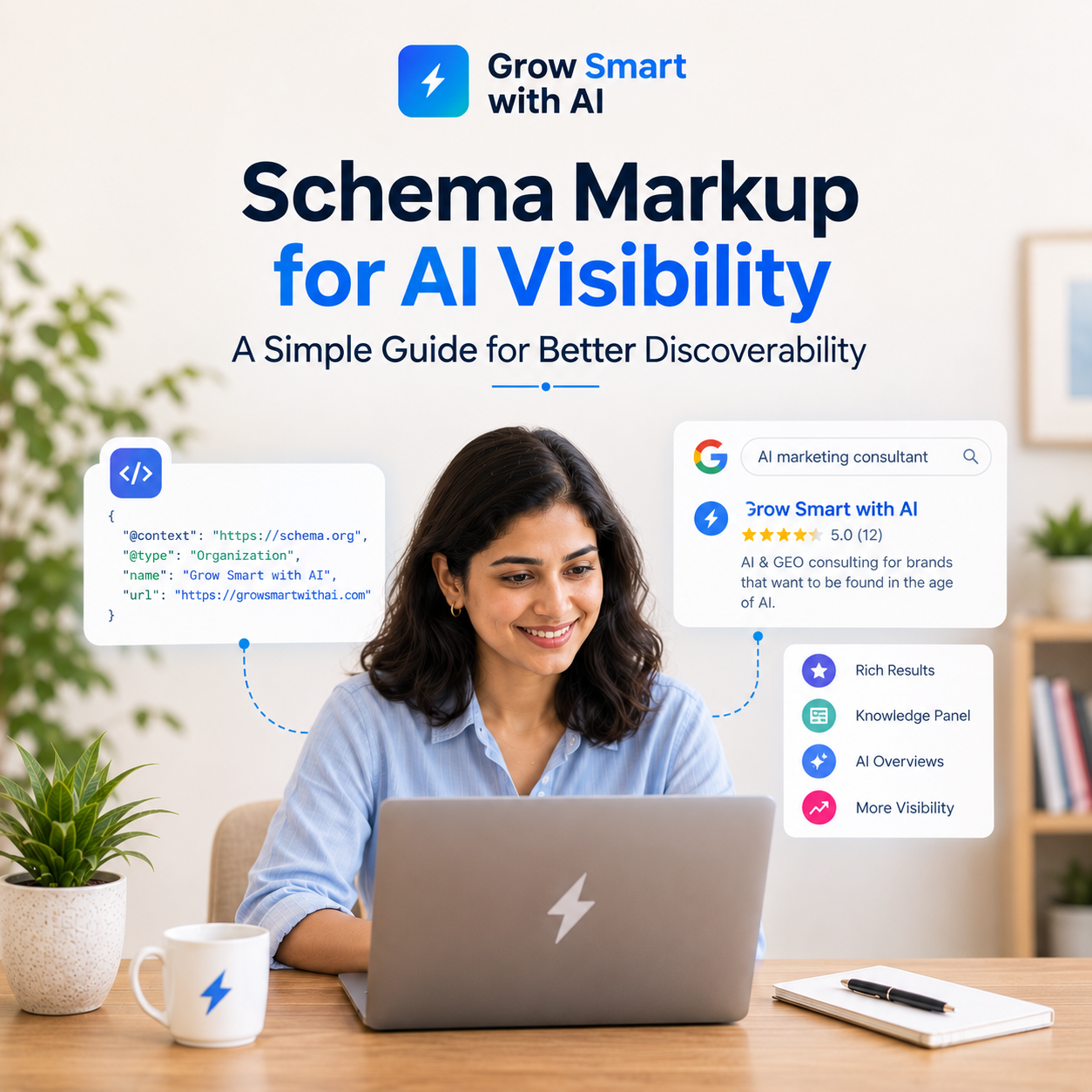
Schema markup for AI visibility is one of the simplest technical fixes an Indian website can make in 2026 — and one of the most overlooked. This guide explains which schema types matter, shows ready-to-use examples and walks you through setting them up in Rank Math.
Schema markup is structured code added to a webpage that tells search engines and AI crawlers exactly what the page means — not just what it says. It’s the difference between a crawler guessing your page is about “AI consulting” and a crawler knowing, with certainty, that it’s an Organization page for a specific company offering specific services.
Table of Contents
Why Schema Markup for AI Visibility Matters in 2026
Search has changed. A growing share of people now ask ChatGPT, Gemini, Perplexity or Google AI Overviews instead of clicking through ten results. Those systems need to decide, in a fraction of a second, what your page is about, who wrote it and whether it can be trusted.
Plain text forces them to guess. Structured data removes the guesswork. That is why schema markup for AI visibility has moved from a “nice to have” for rich snippets to a basic requirement for any Indian business that wants to be named in AI answers.
Schema does not guarantee a citation. Nothing does. But it makes your facts machine-readable, consistent and easy to extract — and that is exactly what AI systems reward when they choose which sources to quote.
What changes when you add schema
- Your brand becomes an entity. Organization schema with sameAs links tells machines that your website, LinkedIn page, Wikidata item and Google Business Profile all describe the same company.
- Your answers become quotable. FAQPage schema packages each question and answer as a clean pair that assistants can lift directly.
- Your authors gain credibility. Person schema connects each article to a real expert, which supports E-E-A-T signals.
- Your offers become comparable. Product and Service schema give AI shopping and comparison answers the price, availability and rating data they need.
How AI Assistants Read Structured Data
Most AI search products work in two stages. First, a crawler such as Googlebot, Bingbot, GPTBot or PerplexityBot fetches your page and stores a processed version of it. Second, when a user asks a question, the system retrieves the most relevant stored pages and asks a language model to write an answer from them.
JSON-LD schema helps at both stages. During crawling, it gives the parser an unambiguous summary of the page. During retrieval, it helps the system match your page to questions about a specific company, person, product or topic. Google has confirmed that structured data helps it understand page content, and Bing, which powers much of ChatGPT’s web search, uses the same Schema.org vocabulary.
The 5 Schema Types That Matter Most for GEO
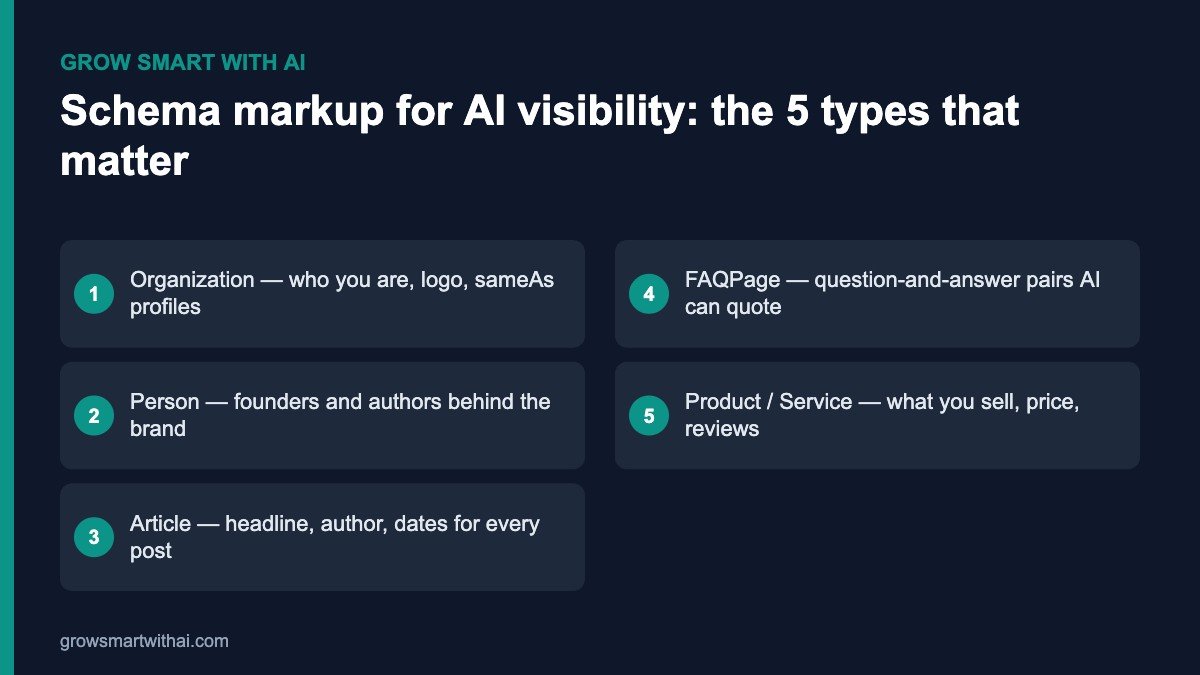
- Organization schema — establishes your company as an entity: name, logo, founding info, social profiles.
- Person schema — does the same for founders and key people; critical if you’re building a personal brand alongside a company one.
- Article schema — tells crawlers a page is a written piece, with author, publish date, and headline.
- FAQPage schema — wraps your FAQ blocks so LLMs can extract question-answer pairs directly. This is the single highest-leverage schema type for AEO.
- Product schema — for anything sold directly, gives price, availability, and review data in structured form.
For a deeper technical walkthrough with JSON-LD examples, see our companion guide: How to add schema markup for LLM visibility.
Adding Schema: Rank Math vs. Manual JSON-LD
Rank Math (recommended for most WordPress sites): Under Schema settings, choose the content type per page (Article, FAQ, Organization) and Rank Math generates the JSON-LD automatically. No code required. This is the setup we use on our own site.
Manual JSON-LD (for custom builds or edge cases): Write a <script type="application/ld+json"> block directly in the page head with the relevant schema.org properties. More control, more maintenance.
For 90% of small business sites, Rank Math’s built-in schema is enough. Manual JSON-LD is worth it only when you need a schema type Rank Math doesn’t support out of the box, or when you’re working outside WordPress.
Common Mistakes
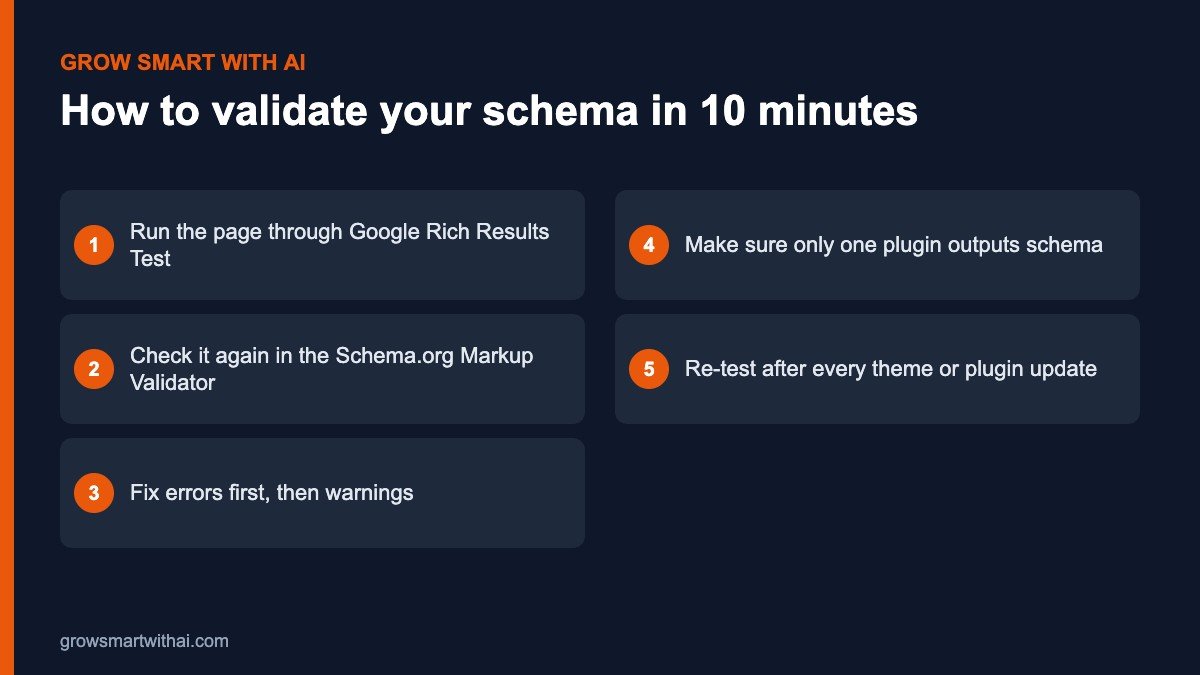
- Duplicate schema — two plugins both outputting Organization schema on the same page confuses crawlers rather than helping them.
- Missing Person schema for founders — Organization schema alone doesn’t establish who’s behind the brand, which matters for GEO trust signals.
- No FAQPage schema on FAQ-heavy pages — the content is there, but without the markup, LLMs have to infer the Q&A structure instead of reading it directly.
Validating Your Schema
Run every page through Google’s Rich Results Test and the Schema Markup Validator before considering the job done. Both are free and flag errors immediately — a broken schema block can be worse than no schema at all, since it signals inconsistency.
Schema Markup Examples for Indian Websites
Below are three short JSON-LD examples you can adapt. Replace the sample details with your own and keep every fact identical to what appears on the visible page.
1. Organization schema for your home page
{
  "@context": "https://schema.org",
  "@type": "Organization",
  "name": "Your Company Pvt Ltd",
  "url": "https://www.yourcompany.in",
  "logo": "https://www.yourcompany.in/logo.png",
  "foundingDate": "2021",
  "address": { "@type": "PostalAddress", "addressLocality": "Bengaluru", "addressCountry": "IN" },
  "sameAs": [
    "https://www.linkedin.com/company/yourcompany",
    "https://www.wikidata.org/wiki/Q000000"
  ]
}
2. FAQPage schema for a service page
{
  "@context": "https://schema.org",
  "@type": "FAQPage",
  "mainEntity": [{
    "@type": "Question",
    "name": "How long does an AI visibility audit take?",
    "acceptedAnswer": { "@type": "Answer", "text": "A standard audit takes 5 to 7 working days." }
  }]
}
3. LocalBusiness schema for your contact page
{
  "@context": "https://schema.org",
  "@type": "ProfessionalService",
  "name": "Your Company",
  "telephone": "+91-00000-00000",
  "address": { "@type": "PostalAddress", "streetAddress": "Street", "addressLocality": "Pune", "postalCode": "411001", "addressCountry": "IN" },
  "openingHours": "Mo-Fr 10:00-18:00"
}
The full list of properties for each type is on Schema.org, and Google’s structured data documentation explains which ones it uses.
Step-by-Step: Setting Up Schema Markup in Rank Math
- Complete the Knowledge Graph settings. In Rank Math → Titles & Meta → Local SEO, choose Organization or Person, add your legal name, logo, address and phone number.
- Add social profiles. Under Titles & Meta → Social Meta, add LinkedIn, Facebook, Instagram, X and your Wikidata URL. Rank Math turns these into sameAs links.
- Set a default schema for posts. Under Titles & Meta → Posts, set the default schema type to Article and the article type to BlogPosting.
- Add FAQ schema where you answer questions. Use the Rank Math FAQ block in the editor. It outputs FAQPage schema automatically.
- Set schema per page. Open the Schema tab in the Rank Math sidebar on service, product and contact pages and pick the matching type.
- Validate and fix. Test every key page, then re-test after major plugin or theme updates.
How to Measure the Impact of Schema on AI Visibility
Schema works quietly, so measure it on purpose. In Google Search Console, open the Enhancements reports to confirm valid FAQ, Article and Breadcrumb items. In Bing Webmaster Tools, check the same pages under URL Inspection. Then, once a month, ask ChatGPT, Perplexity and Gemini the five questions your customers ask most and note whether your brand or page is cited.
Most sites see Search Console show valid items within a few days. Changes in AI answers take longer — usually six to twelve weeks — because AI systems refresh their indexes on their own schedules. Combine schema with an llms.txt file and a crawler-friendly robots.txt for the strongest effect.
Schema markup for AI visibility: a quick summary
Start with Organization and Person schema so machines know who you are. Add Article schema to every post and FAQPage schema to every page that answers questions. Validate everything, keep the facts consistent with your visible content, and review it each quarter. That simple routine covers almost everything Indian websites need from schema in 2026.
Which Schema Each Type of Indian Business Needs
Every business needs Organization schema, but the next most useful type depends on what you sell and how customers find you. Here is a simple guide by business model.
D2C and e-commerce brands
Product schema with Offer and AggregateRating is the priority. Include price in INR, availability, brand, GTIN or SKU, and genuine review data. AI shopping answers in ChatGPT, Perplexity and Google lean heavily on this structured product information when they compare options. Add FAQPage schema to category pages that answer sizing, delivery and returns questions.
SaaS and tech startups
Use SoftwareApplication schema for your product page, with operating system, application category, pricing and rating. Pair it with Organization schema that links to your Crunchbase, LinkedIn, G2 and Wikidata profiles. This helps assistants answer “best tools for…” questions with your product included.
Consultancies, agencies and B2B services
Service schema on each service page, with areaServed set to India or the specific cities you cover, makes your offer clear. Add Person schema for your founders and senior consultants, because B2B buyers — and the AI tools they use — care about who is behind the work.
Clinics, coaching centres and local businesses
LocalBusiness schema, or a more specific subtype such as MedicalClinic or EducationalOrganization, is essential. Keep the name, address and phone number identical to your Google Business Profile. Opening hours, price range and geo coordinates all help voice and local AI answers.
Educators, authors and personal brands
Person schema is your foundation, with jobTitle, worksFor, alumniOf and sameAs links to your LinkedIn and Wikidata profiles. Add Course schema for courses and Book schema for books, so assistants can connect your work to your name.
Advanced Tip: Connect Your Entities With @id and sameAs
Once the basics are in place, the next improvement is to connect your schema blocks to each other. Give your Organization a stable identifier, such as https://www.yourcompany.in/#organization, and reference that same @id as the publisher of every Article and the provider of every Service.
Then use sameAs to point to every trusted profile that describes the same entity — LinkedIn, Crunchbase, Wikidata, your Google Business Profile and major directory listings. Together, @id and sameAs turn scattered pages into one clear knowledge graph. This is the single most useful step for entity SEO, and it is something most Indian websites still miss. Rank Math does much of this automatically once your Knowledge Graph settings are complete.
Does schema slow down my website?
No. JSON-LD is a small block of text in the page source, usually a few kilobytes. It does not load images or scripts and has no noticeable effect on page speed or Core Web Vitals.
Can wrong schema hurt my rankings?
Schema that misrepresents the page — fake reviews, prices that do not match, or FAQ content that is not visible to users — can lead to a manual action from Google. Keep every value in your schema identical to what visitors can see, and you will stay on the safe side.
A 30-Minute Schema Audit You Can Run Today
If you are not sure where your website stands, this short audit will tell you. You only need a browser and a notebook.
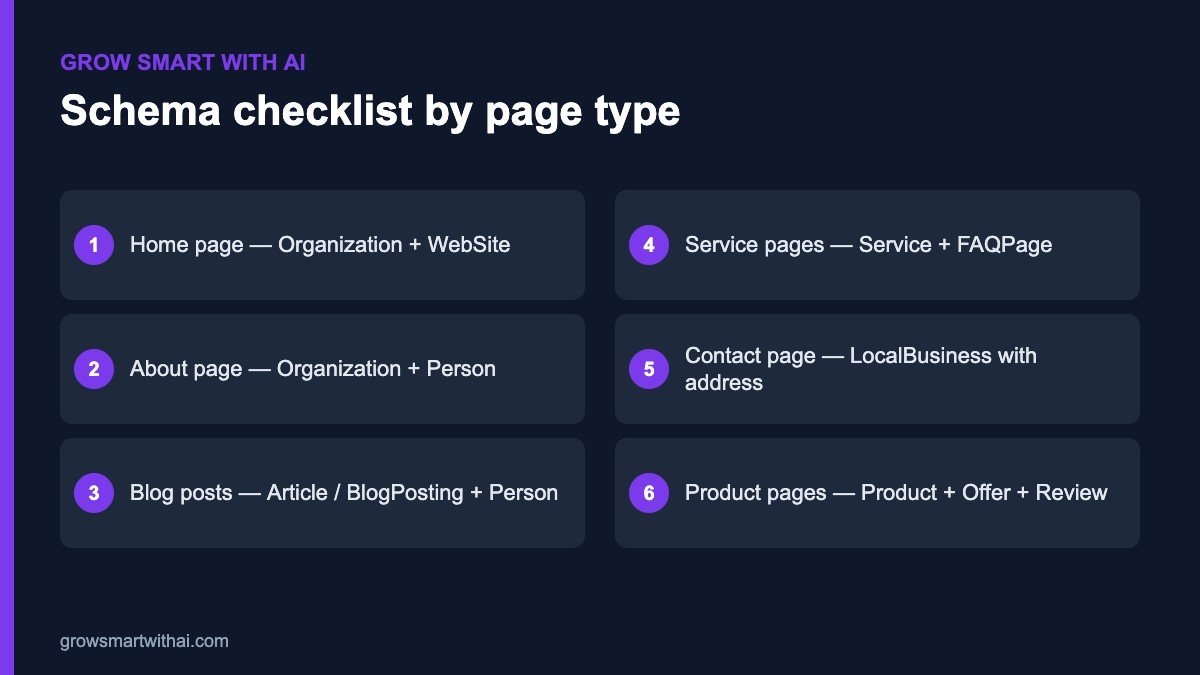
- Test your home page. Paste the URL into the Schema Markup Validator. You should see Organization or LocalBusiness, plus WebSite. Note any errors.
- Test your About page. Look for Person schema for each founder. If it is missing, add it — this is a common gap for Indian startups.
- Test two blog posts. Each should show Article or BlogPosting with a named author, a publish date and a modified date.
- Test your main service or product page. Look for Service, Product or SoftwareApplication schema, and FAQPage if the page answers questions.
- Look for duplicates. If you see two Organization blocks or two Article blocks, two plugins are outputting schema. Switch one off.
- Check your sameAs links. Open each link and confirm it goes to a live profile with the same name and logo.
- Write down three fixes. Do the easiest one today, the next one this week, and the third before the end of the month.
Repeat this audit every quarter, and every time you redesign the site or change SEO plugins. Schema rarely breaks loudly — it breaks silently, and AI visibility drops without any warning. A short, regular check is the cheapest insurance you can buy for schema markup for AI visibility.
If you would like a second pair of eyes, our team reviews schema as part of every AI visibility audit, and our companion guide on adding schema markup for LLM visibility goes deeper into the code.
One last point: schema is not a one-time project. Every new service, product, team member or blog post is a chance to add accurate structured data. Build it into your publishing checklist — title, meta description, featured image, schema — and it will quietly keep working for your brand on Google, Bing, ChatGPT, Perplexity and every new AI assistant that launches after them.
FAQ
Does schema markup help with ChatGPT visibility, not just Google?
Yes. While schema was built for search engines, LLMs trained on or crawling the web pick up the same structured signals — a well-marked-up FAQ page is easier for any AI system to extract clean answers from.
Is Rank Math enough, or do I need custom JSON-LD?
Rank Math covers the core schema types most small business and consulting sites need. Custom JSON-LD is only necessary for schema types outside its built-in list, or non-WordPress sites.
How often should schema be checked?
Re-validate after any major site redesign or plugin update — these are the most common points where schema breaks silently.
Book a free 45-minute live GEO audit →
More guides: Grow Smart with AI blog.
Further reading: Bing Webmaster Tools, Schema.org documentation, and Google structured data intro.
schema markup AI visibility guide continues to matter as Indian buyers shift from Google-only research to ChatGPT, Perplexity, and Copilot. Consistent entity signals, schema markup, llms.txt, Bing Webmaster Tools verification, and AEO-structured content compound over 90 days. Brands that implement these steps early tend to own category answers before competitors catch up.
Practical note on schema markup AI visibility guide: Indian brands should document entities, publish corroborating pages, and measure LLM citations monthly.
Teams implementing schema markup AI visibility guide often combine schema markup, Bing Webmaster Tools, and AEO-formatted FAQs for faster AI visibility.
When you prioritise schema markup AI visibility guide, focus on clear definitions, expert authorship, and outbound references that models can verify.