When someone asks ChatGPT who to hire or buy from in your category and your name never surfaces, that is not a minor rankings dip — it is an existence gap for that assistant at that moment. This guide unpacks why it happens so often for Indian brands — and what to change starting today.
Signals worth tracking alongside SEO rankings
GEO rewards citation frequency inside assistants — not only blue-link clicks. Before rewriting campaigns, anchor expectations:
What does “invisible on ChatGPT” actually mean?
It means that for certain conversational prompts — not branded searches for your URL — the model does not yet associate your brand strongly enough with the category answer it wants to assemble. Traditional SEO wins do not automatically transfer; assistants prioritise clarity of entity, answer-shaped content and corroborating mentions elsewhere on the web.
I want to tell you about a conversation I had three months ago with a founder in Bangalore.
She ran a boutique D2C skincare brand — good products, loyal customers, decent Instagram following. She'd invested heavily in SEO over two years. Her website ranked on page one for a handful of solid keywords. She was, by most classic digital measures, doing well.
Then she opened ChatGPT and typed: “What are some good Indian skincare brands focused on Ayurvedic formulations?”
Her brand wasn't there. Not even close.
Five other brands were mentioned. All of them had weaker SEO than hers. Some had fewer reviews. One had launched eighteen months after her. She sat with that for a minute, and then asked me: “How is this possible?”
The answer changed how she thought about marketing — and it's what I want to share with you today.
Why most Indian brands are invisible on ChatGPT right now
The short answer: ChatGPT doesn't behave like Google's crawler ledger. For many prompts it draws heavily on patterns learned during training plus retrieval signals — and if your brand hasn't appeared consistently, authoritatively and clearly in machine-readable contexts, it struggles to amplify you into answers.
Here are the five causes I see most often when auditing Indian brands:
1. Your brand has no consistent entity definition
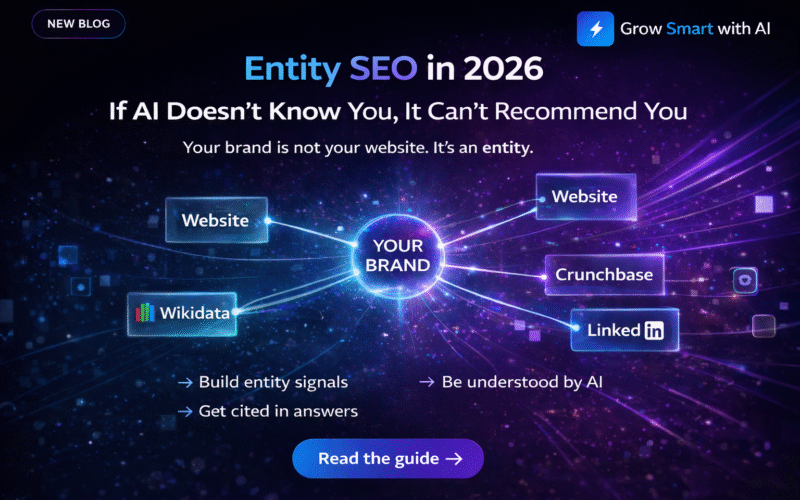
When I type “Grow Smart with AI” across five surfaces — site, LinkedIn, press, Google Business Profile — the description says essentially the same thing: name, mission, audience, wedge problem. That redundancy gives assistants a crisp entity map.
Most brands fail this test: the website claims one positioning, LinkedIn another, About Us drifts again. To a language model that inconsistency reads as noise — and noisy entities rarely get elevated.
Fix: Draft a 50-word and a 150-word brand description today. Paste them verbatim everywhere those summaries appear.
2. Your content answers hardly anyone — it mostly describes
Classic collateral boasts: “We are a leading provider of X.” Answer-ready copy asks and resolves: “What problem does this solve? For whom? How does delivery work?” Assistants amplify prose shaped like dialogue, not brochures.
The skincare founder's site had lyrical storytelling — but almost no interrogative scaffolding: FAQs, comparisons, objections handled explicitly. Combine that with absent FAQ schema and assistants lack hooks.
3. You barely exist in third-party sources
Much of what ChatGPT-class models learned still rides on external narratives — reporting, forums, Wikipedia-class pages, respected newsletters. If your brand only echoes inside your domain you're essentially talking to yourself.
In India, disciplined mentions on credible publishers (YourStory, Inc42-style beats, thoughtful Quora threads) remain relatively affordable versus paid media yet compound LLM familiarity.
4. You diluted topical authority
Models associate entities with themes via sustained publishing. Twenty thoughtful essays on GEO for Indian founders beats two GEO posts buried amid thirty unrelated essays — repetition builds reputational gravity.
5. Your technical layer whispers nothing to machines
Schema markup — Organisation, FAQPage, Article — states explicitly what humans infer. Indian SMEs routinely skip this entirely; assistants must guess structure from messy DOM trees instead.
For the technical crawl/access checklist our CTO publishes separately, see robots.txt & AI crawler allowances and our broader LLM visibility playbook.
The ninety-day turnaround — skincare founder recap
We executed four coordinated moves:
- Entity rewrite: identical positioning snippets replicated across digital surfaces.
- FAQ deployment: category + homepage FAQs wrapped with FAQPage schema.
- Authority publishing: three interrogative guides on Ayurvedic skincare transparency and regimen selection.
- External corroboration: two credible citations — editorial mention plus creator coverage with crawl-friendly domains.
At ninety days she reran the identical ChatGPT prompt — her brand appeared third among five listings with accurate differentiation. That's what systematic GEO hygiene unlocks.
DIY — five-step ChatGPT visibility audit (today)
- Baseline assistants: Ask ChatGPT, Perplexity, Gemini and Claude the five category prompts your buyer truly uses. Screenshot citations verbatim.
- Entity consistency sweep: Google your brand — scan ten snippets. Divergence equals remediation.
- Homepage Turing test: Does paragraph one answer “what is this company and why exist?” Taglines alone fail.
- Mention ledger: Track credible external references over six months — fewer than five means outbound storytelling becomes priority.
- Schema sanity: Run your homepage through validator.schema.org. Empty graph equals urgent technical wins.
Your gaps become your GEO backlog — tackle entity + structured answers before bidding wars on vanity SERPs.
What I tell founders asking this question weekly
Invisibility isn't destiny — it signals mismatched investments. GEO rewards clarity, usefulness and corroboration even more than polished prose alone.
The brands assembling LLM familiarity now inherit the next wave of Indian buyers asking assistants for shortcuts. That behavioural shift is live — not distant speculation.
The only outstanding variable is whether your brand occupies the sentence assistants dare utter aloud.
Book a free 30-minute LLM visibility audit →
Live screens across ChatGPT-class assistants — zero obligation.
About the author
Sushmita Sen Gupta is Co-Founder & Chief Strategy Officer of Grow Smart with AI — India's GEO and AEO consultancy. National AI Olympiad Merit 2025 (Accenture), AI Innovation Leader 2025, AI Trailblazer 2025. ISB Hyderabad · IIT Delhi AI & Tech Leadership · 20+ years leading global brands. Author of Everyday AI: A Minimal Practical Guide.
growsmartwithai.com · © 2026 Grow Smart with AI
Why isn’t my brand appearing in ChatGPT even though I rank well on Google?
Google rankings lean on crawl metrics, links and on-page SEO. ChatGPT-style answers lean on how consistently your brand is described across authoritative text, structured schema and corroborating third-party mentions. You can hold page-one SERPs yet remain unnamed in AI answers if entity clarity is weak.
How quickly can my brand start appearing in ChatGPT?
Faster-retrieval engines such as Perplexity may shift within a few weeks of publishing structured, citation-ready content. ChatGPT mentions tied to training and Bing-mediated browsing commonly need roughly three to six months of disciplined GEO execution.
Do I need to pay ChatGPT to appear in answers?
No. Placement is not bought like sponsored listings — it reflects depth of entity evidence, schema quality and external mentions. Budget goes into execution, not direct placement fees.
Is there a tool to track AI answer mentions?
The most reliable method today is a monthly manual panel across ChatGPT, Perplexity, Gemini, Copilot and Claude with a fixed prompt script (Grow Smart with AI runs this for clients). Vendors such as Profound and Otterly are expanding automated monitoring — evaluate frequently because the category evolves weekly.