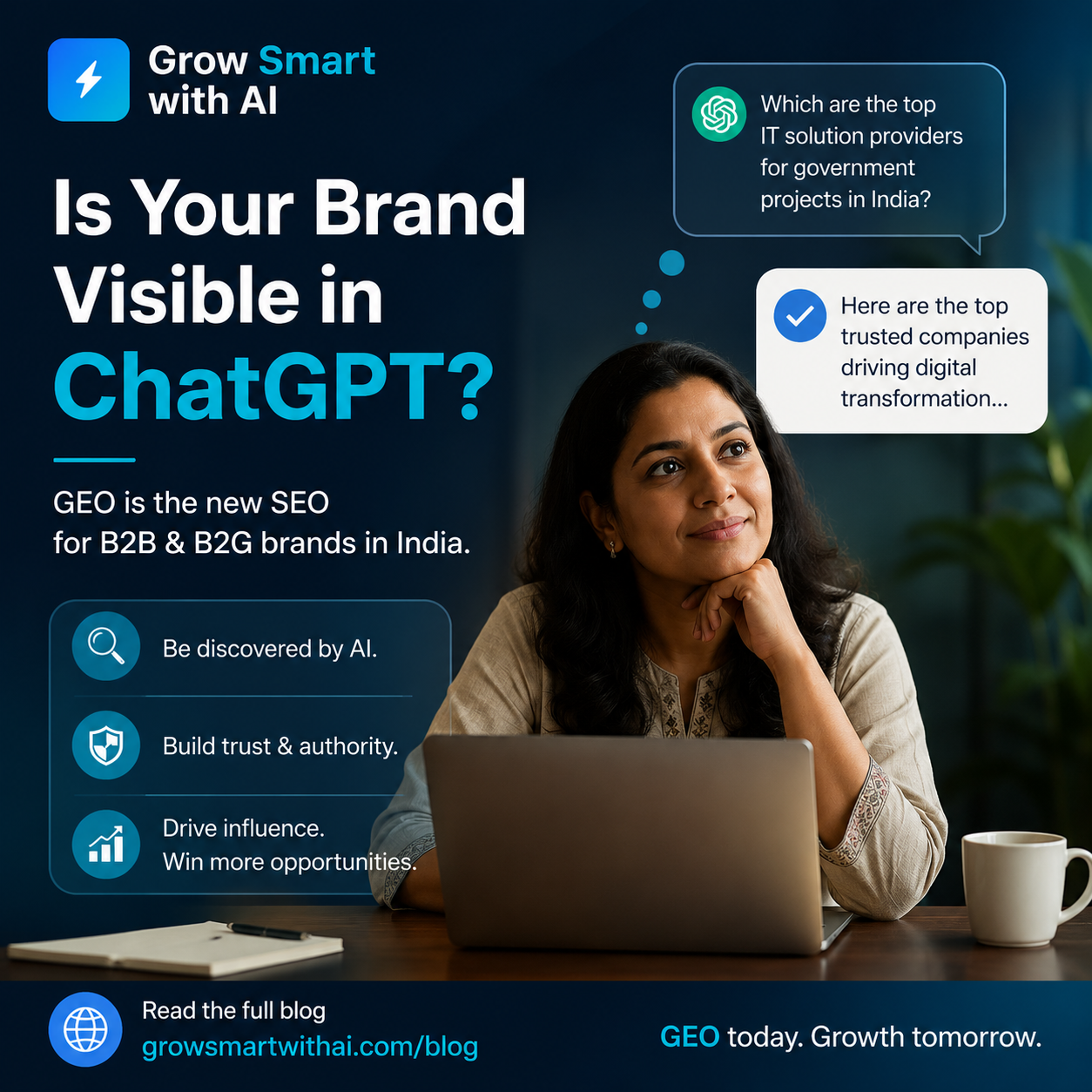
GEO for B2B and B2G firms is no longer optional. Decision-makers in companies and government now use ChatGPT and Perplexity to understand problems and shortlist partners. This guide shows Indian consultancies, policy advisors and senior professionals how to be one of the names those assistants recommend.
B2B and B2G brands face a specific AI visibility challenge that consumer brands do not. Their buyers — enterprise decision-makers, government procurement officers, institutional investors — do not browse Instagram or click on Google ads. They ask colleagues, read industry reports, and increasingly, they ask ChatGPT.
“Who is the leading AI governance consultant in India?””Which firm provides GEO services for enterprise brands?””Who does digital transformation advisory for government in India?”
These are real queries that real decision-makers are typing into AI platforms right now. If your firm does not appear in the answer — a competitor does. And that citation carries the weight of a peer recommendation, not an advertisement.
This guide covers the specific GEO actions that work for B2B and B2G contexts — different in several important ways from D2C or startup GEO.
Table of Contents
How B2B and B2G GEO Differs from Consumer GEO
Consumer GEO relies heavily on product schema, review aggregation, and social proof. B2B and B2G GEO relies on:
- Expert positioning — your named principals being recognised as authorities in their domain
- Institutional credibility — government credentials, academic affiliations, industry body memberships
- Thought leadership content — long-form articles, research papers, policy submissions
- Peer citations — being mentioned by other credible institutions and senior professionals
- Professional directory presence — Clutch, GoodFirms, LinkedIn, and sector-specific directories
For a B2G consultant, one mention in a NITI Aayog report or a Ministry of Electronics publication creates more GEO authority than 100 blog posts. The signal that AI systems trust for B2G brands is institutional association, not volume.
6 Practical GEO Actions for B2B and B2G Brands
Action 1 — Build named expert authority for your principals
In B2B and B2G, the firm’s credibility is built through the credibility of its people. AI systems cite named experts — not anonymous firms. Every senior professional in your organisation needs:
- A complete LinkedIn profile with specific expertise keywords in the headline
- A Wikidata Person entry linked to the firm’s Wikidata entry
- A published author or speaker presence — LinkedIn Articles, conference proceedings, industry reports
- A consistent bio across all digital touchpoints — website, LinkedIn, event pages, publications
Action 2 — Create a Service schema for your offerings
Unlike product schema for D2C brands, B2B and B2G firms need Service schema — specifically the properties that tell AI systems what services you offer, to whom, and in which geographies.
- Service name: be specific — “AI Governance Advisory” not “consulting”
- provider: your firm’s Organisation schema entity
- areaServed: India — and specific states or sectors if relevant
- audience: be specific — “government departments”, “enterprise”, “multilateral organisations”
- description: 100-word answer to “what does this service do and who is it for”
Action 3 — Publish thought leadership on high-DA platforms
For B2B and B2G brands, the highest-value content is not on your own website — it is on external platforms that your buyers trust. Priority platforms:
- LinkedIn Articles — DA 94, indexed by Perplexity, read by enterprise decision-makers
- ORF (Observer Research Foundation) — for policy and governance content
- NASSCOM Community — for technology and digital transformation content
- Industry association publications — CII, FICCI, ASSOCHAM
- Academic platforms — ResearchGate, SSRN for research-based firms
- Press: ET, Mint, Business Standard for enterprise visibility
Action 4 — Get listed on institutional directories
B2B and B2G decision-makers use specific directories to find service providers. Perplexity reads these directories when answering procurement-style queries:
- Clutch.co — filter by B2B services, IT consulting, management consulting
- GoodFirms.io — same categories
- NASSCOM Member Directory — if eligible, this is high-credibility for tech firms
- GeM (Government e-Marketplace) — for B2G firms, a GeM listing is a procurement signal
- World Bank Consultant Registry — for development sector advisory firms
Action 5 — Make your case studies AI-readable
B2B and B2G buyers need evidence of past delivery before engaging. AI systems read case studies when deciding whether to cite a firm for capability queries. Structure every case study as:
- Client sector (without naming the client if confidential)
- Problem: specific, measurable
- Solution: your specific service delivered
- Outcome: measurable result
- Add CaseStudy schema or HowTo schema to make it machine-readable
Action 6 — Build a Consistent Positioning Statement
The single most important GEO action for B2B and B2G firms is deciding on one positioning statement and using it identically everywhere. AI systems cite firms that have a clear, consistent, verifiable positioning — not firms that describe themselves differently on every page.
The statement should be:
- Under 25 words
- Specific about what you do (not “consulting”)
- Specific about who you serve (not “enterprises”)
- Specific about your differentiation (what makes you different)
- Used identically on website, LinkedIn, Wikidata, Clutch, and all directories
The B2B/B2G GEO Audit
Open ChatGPT and Perplexity. Run these queries substituting your specific category:
- “Best [your service] consultancy India”
- “[Your category] advisory firm Indian government”
- “Who provides [your service] for [your client sector] in India”
- “[Your founder’s name] [their area of expertise]”
Which firms appear? What do their digital presences have that yours does not? The six actions above address every gap you will find.
Book a free 45-minute live GEO audit →
We run your category queries across ChatGPT, Perplexity, Gemini, Copilot, and Claude in real time.
How B2B Buyers Use AI Assistants to Shortlist Firms
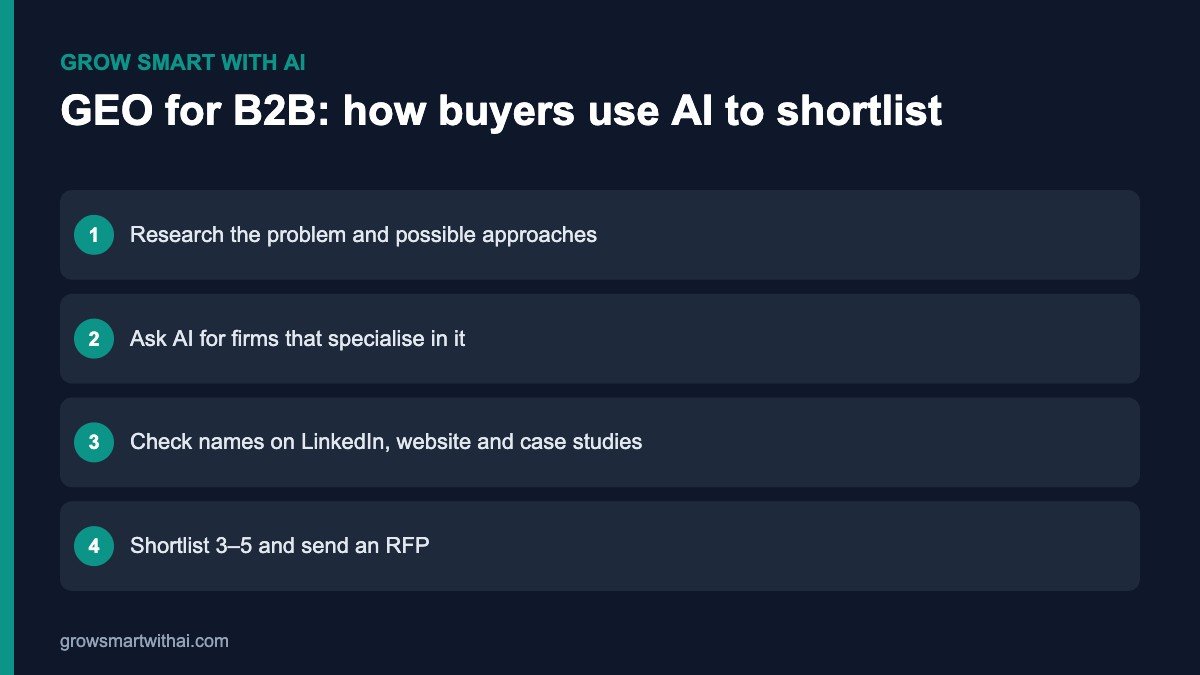
B2B buying in India has changed quietly. Before a procurement head, CXO or programme director talks to any vendor, they now research with AI. They ask ChatGPT to explain a problem, compare approaches and suggest firms that specialise in it. They ask Perplexity for “top ESG consultancies in India” or “firms that help state governments with digital public infrastructure”. Only then do they visit websites and LinkedIn profiles.
That makes GEO for B2B a pipeline issue, not just a marketing one. If your consultancy is not named in those early AI answers, you may never be invited to pitch — no matter how good your work is.
The good news is that B2B and B2G categories are usually narrow and specialised. There are far fewer competitors for “public health programme evaluation consultancy India” than for “best running shoes”. A focused GEO effort can make a mid-size firm the obvious answer in its niche.
The Trust Signals That Matter Most for GEO for B2B
AI assistants are cautious about recommending firms for high-stakes decisions. They look for evidence that a firm is real, specialised and credible. These are the signals that carry the most weight.
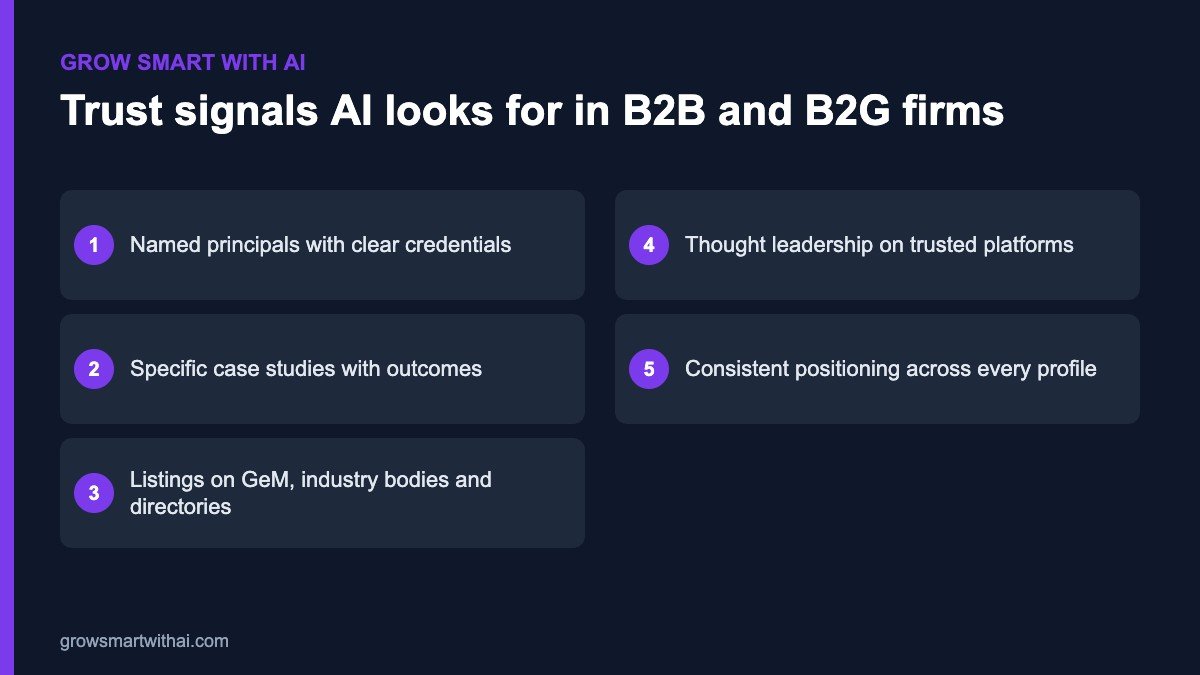
- Named experts. Partners and principals with clear titles, sector experience and public profiles. Buyers hire people; assistants describe people.
- Specific case studies. Pages that describe real problems, approaches and results — with numbers wherever confidentiality allows.
- Institutional listings. Profiles on GeM, industry associations such as NASSCOM, CII or FICCI, and empanelment pages of ministries or multilateral agencies.
- Thought leadership. Reports, op-eds and articles on trusted platforms, including Indian business media and sector journals.
- Consistency. The same positioning statement, service names and leadership details on your website, LinkedIn, directories and proposals.
B2G GEO: Getting Found for Government and Public-Sector Work
Government and public-sector buyers behave differently. Decisions are formal, documented and often based on empanelment, past performance and compliance. But the people who write terms of reference and evaluate proposals still research with AI tools, and they still look for credible, experienced partners.
- Publish your public-sector experience clearly. Create a dedicated page for government work, listing departments served, programme types and outcomes, within what your contracts allow you to share.
- Keep registrations visible. If you are registered on GeM or empanelled with a ministry, state it on your website with the relevant category.
- Share knowledge products. Policy briefs, evaluation summaries and public reports, published as text-based web pages rather than only as PDFs, are highly citable.
- Be present where policy is discussed. Contributions to think-tank publications, conference proceedings and sector newsletters build independent references to your expertise.
Making Case Studies AI-Readable
Most consultancy case studies are written for a slide deck: logos, bold claims and very few facts. AI assistants need the opposite. Rewrite your top five case studies using a simple, consistent structure.
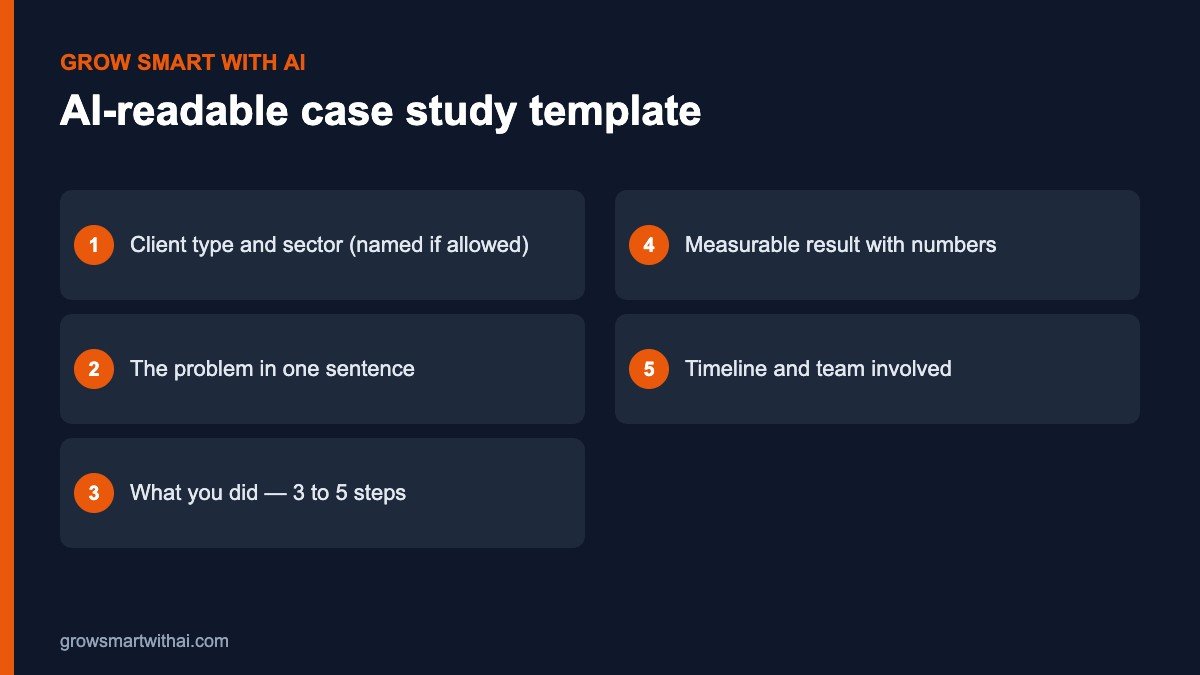
Use a clear heading such as “How we helped a state health department cut vaccine wastage by 18%”. Start with one sentence describing the client type and the problem. Then explain what you did in three to five steps, give the measurable result, and close with the timeline and team. Publish it as an HTML page with Article schema and the names of the consultants involved. That one change makes your experience far easier for any assistant to understand and cite.
Thought Leadership That AI Assistants Cite
Not all content is equal. For GEO for B2B, the most valuable pieces are those that answer the specific, practical questions decision-makers ask. “How should a mid-size Indian bank approach an AI governance framework?” is far more useful than “The future of AI in banking”.
Publish in three places: on your own website as a detailed guide, on LinkedIn as an Article by the relevant partner, and — where possible — as a guest piece or interview in a respected Indian publication. Our guide to LinkedIn GEO explains how to build personal authority for your principals, and the entity SEO guide shows how to connect people and firm together.
Measuring GEO for B2B Results
Write down 15 prompts your buyers might use — including sector, geography and service — and test them monthly on ChatGPT, Perplexity, Gemini and Claude. Record whether your firm is named, how it is described and which sources are cited.
In parallel, ask every new enquiry how they found you, and include “AI assistant such as ChatGPT” as an option. B2B sales cycles are long, so look for leading signals: more accurate AI descriptions of your firm, more branded searches, and inbound RFPs that mention specific case studies you have published.
Common Mistakes Consultancies Make With AI Visibility
- Hiding experts behind the brand. A website that never names its partners gives AI assistants nobody to describe or recommend.
- PDF-only knowledge. Reports locked in PDFs are harder to read and cite than the same insights published as web pages.
- Generic service names. “Strategy and transformation” could mean anything. “Digital transformation for Indian cooperative banks” is specific and matchable.
- Out-of-date team pages. Former partners and old titles create conflicting signals across sources.
- Ignoring directories. Industry association listings and procurement registrations are dull but highly trusted sources.
- No measurement. Without a monthly prompt test, it is impossible to know whether your efforts are working.
A 90-Day GEO Plan for Indian Consultancies
Month 1: Write one clear positioning statement and use it everywhere. Update partner bios on your website and LinkedIn with consistent titles and sector experience. Add Organization, Person and Service schema. Month 2: Rewrite your five strongest case studies in the AI-readable format and publish one practical guide on the question your buyers ask most. Month 3: Complete institutional listings, secure one external article or interview for a senior partner, and run your prompt test again.
This plan fits alongside client work. Most firms can assign it to one marketing lead with a few hours a week from the partners — and the assets it creates keep working for years.
GEO for B2B and B2G: FAQ
Is GEO relevant for firms that win work mainly through tenders?
Yes. Tenders are decided on formal criteria, but evaluators and programme teams still research partners. Being described accurately and credibly by AI tools supports your reputation throughout the process.
Can we share client names?
Only with permission. When you cannot, describe the client type, sector and scale instead — “a central PSU in the energy sector” is still useful information.
How long does GEO take for a consultancy?
Expect three to six months for clear improvements, as case studies, articles and listings accumulate and AI systems refresh their information.
Do small consultancies stand a chance against the Big Four?
Yes. AI assistants often recommend specialists for specific questions. A boutique firm with deep, well-documented expertise in a narrow area can be named ahead of much larger firms that only describe that area in general terms.
Should every partner be on LinkedIn?
Ideally, yes. Complete, consistent partner profiles are some of the most useful evidence an AI assistant can find about who your firm is and what it knows. Even a simple profile with an accurate title, sector focus and two or three published articles makes a difference.
What is the quickest win?
Rewrite your home page opening so it says, in one plain sentence, exactly what you do, for whom and where. It is the single change that most improves how AI assistants describe a B2B firm.
About the author
Sushmita Sen Gupta is Co-Founder & CSO of Grow Smart with AI — India’s AI-powered digital marketing and GEO/AEO consultancy. AI Trailblazer 2025 (Government of India). 20+ years across IBM, Unilever, Rolls Royce, Bosch and Huawei through Ogilvy and Mather. Author of Everyday AI: A Minimal Practical Guide.
growsmartwithai.com · © 2026 Grow Smart with AI
How can a B2B consultancy in India appear on ChatGPT and Perplexity?
B2B consultancies in India appear on ChatGPT and Perplexity by building entity authority through LinkedIn Articles, Wikidata entries for the firm and key principals, thought leadership content with schema markup, directory listings on Clutch and GoodFirms, and consistent expert positioning across all digital touchpoints.
What is the difference between B2B GEO and D2C GEO?
B2B and B2G GEO relies on named expert authority, Service schema, institutional directory presence, and peer citations. D2C GEO relies on Product schema, review aggregation, and buyer-question FAQ content.
Do B2G consultants need different GEO tactics than B2B?
Yes. B2G brands benefit most from institutional associations — government publications, GeM listings, policy submissions, and sector-specific directories — rather than social proof or product reviews.
How important is Wikidata for B2B firms?
Very. Wikidata Person entries for principals and an Organisation entry for the firm create entity anchors that AI systems use to verify experts and consultancies are real and credible.
How long before a B2B consultancy appears on ChatGPT?
With consistent entity building — Wikidata, Service schema, LinkedIn Articles, and directory listings — many B2B firms see movement within 90-120 days. Perplexity typically takes longer due to its reliance on third-party press citations.
More guides: Grow Smart with AI blog.
Further reading: Bing Webmaster Tools, Schema.org documentation, and Google structured data intro.
Practical note on GEO B2B B2G India consultancy ChatGPT: Indian brands should document entities, publish corroborating pages, and measure LLM citations monthly.
Teams implementing GEO B2B B2G India consultancy ChatGPT often combine schema markup, Bing Webmaster Tools, and AEO-formatted FAQs for faster AI visibility.
When you prioritise GEO B2B B2G India consultancy ChatGPT, focus on clear definitions, expert authorship, and outbound references that models can verify.
Practical note on GEO B2B B2G India consultancy ChatGPT: Indian brands should document entities, publish corroborating pages, and measure LLM citations monthly.