Want to get cited on Claude? You are early — and that is an advantage. Very few Indian brands are optimising for Anthropic’s assistant yet, even though it is widely used by developers, consultants and senior decision-makers. This guide explains how Claude chooses its sources and the exact steps to become one of them.
Claude cites brands that show up as authoritative, well-structured sources in its training data and connected search — not brands with the most social mentions. It leans on long-form written depth over recency signals.
That’s the single biggest difference from ChatGPT, and most Indian brands haven’t adjusted their content for it.
Table of Contents
Why Claude Behaves Differently From Other AI Assistants
It weights depth over freshness. Claude tends to favor comprehensive, well-organized pages over recently published ones. A three-year-old explainer page with real structure can outrank a blog post from last week.
It doesn’t always have live web access. Depending on how it’s deployed, Claude may answer from training data alone rather than a live index. That makes getting into durable, high-quality sources (Wikipedia, Wikidata, established publications) more valuable than chasing weekly content freshness.
Almost nobody in India is optimizing for it specifically. Everyone’s chasing ChatGPT and Google AI Overviews. Claude is the quiet gap.
4 Actions to Start This Week
- Publish long-form explainer pages, not just short blog posts — 1,200+ words with clear structure beats five short posts on the same topic.
- Get referenced in Wikipedia or Wikidata — this is one of the strongest anchors for any LLM, Claude included. See our Wikidata entry guide.
- Avoid thin, AI-generated filler pages — Claude’s training tends to deprioritize content that reads as templated or low-effort.
- Add an llms.txt file to your site — a simple, emerging standard that tells AI crawlers what your site is about and which pages matter most. Full walkthrough: llms.txt guide.
How Claude Finds and Cites Sources
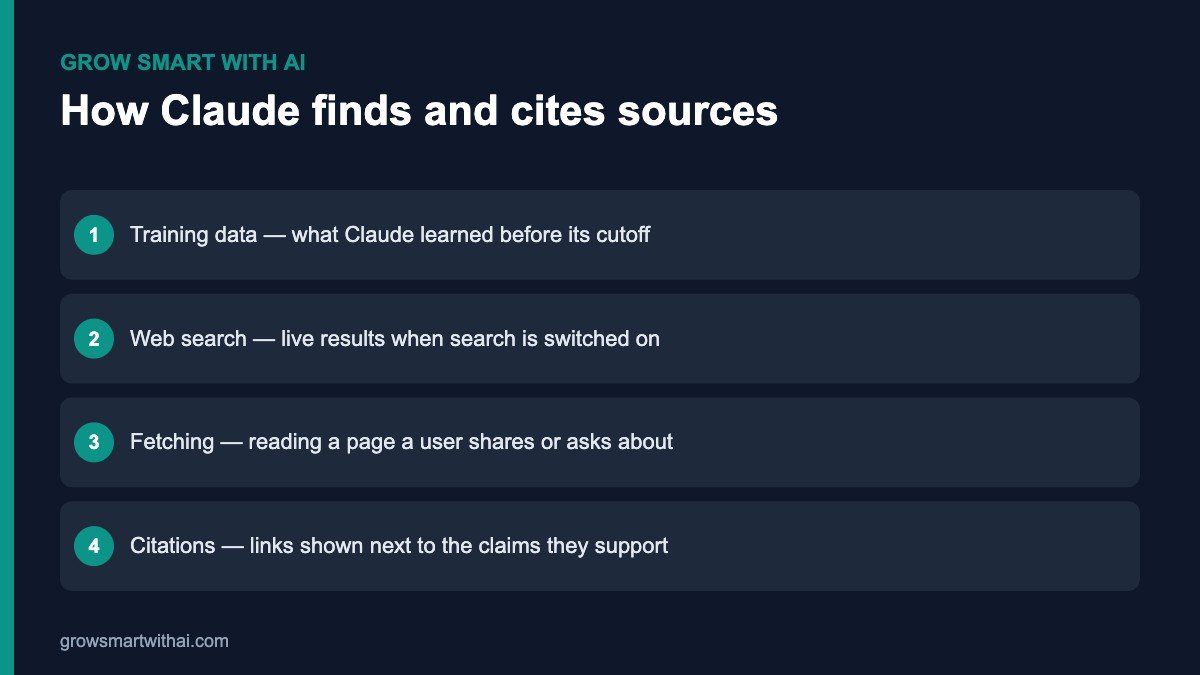
To get cited on Claude, it helps to understand the three ways Claude can know about your brand. Each one rewards slightly different work.
1. Training data. Claude learns from a large body of public web content collected before its training cutoff. If your brand was described clearly and consistently on trusted pages before that date, Claude may mention you even without searching. This is slow to influence but very durable.
2. Web search. In the Claude apps, users can switch on web search. Claude then runs searches, reads the results and writes an answer with inline citations — clickable links next to the claims they support. This is where most new brands can win citations quickly.
3. Fetching a page. When a user pastes a link or asks Claude to look at a specific site, Claude reads that page directly. If your page is blocked, slow or full of scripts, Claude may not be able to read it at all.
Anthropic’s crawlers and what they do
Anthropic publishes the user agents it uses, and each one matters for a different stage. ClaudeBot collects public web content that may be used for training. Claude-SearchBot helps build the search index Claude uses to answer questions. Claude-User fetches pages when a person asks Claude about a specific URL. You can read the details on Anthropic’s support site.
If your robots.txt blocks these agents — or your hosting firewall blocks unfamiliar bots — you are invisible to Claude no matter how good your content is. Our guide to fixing robots.txt for AI crawlers shows exactly what to allow.
7 Steps to Get Cited on Claude
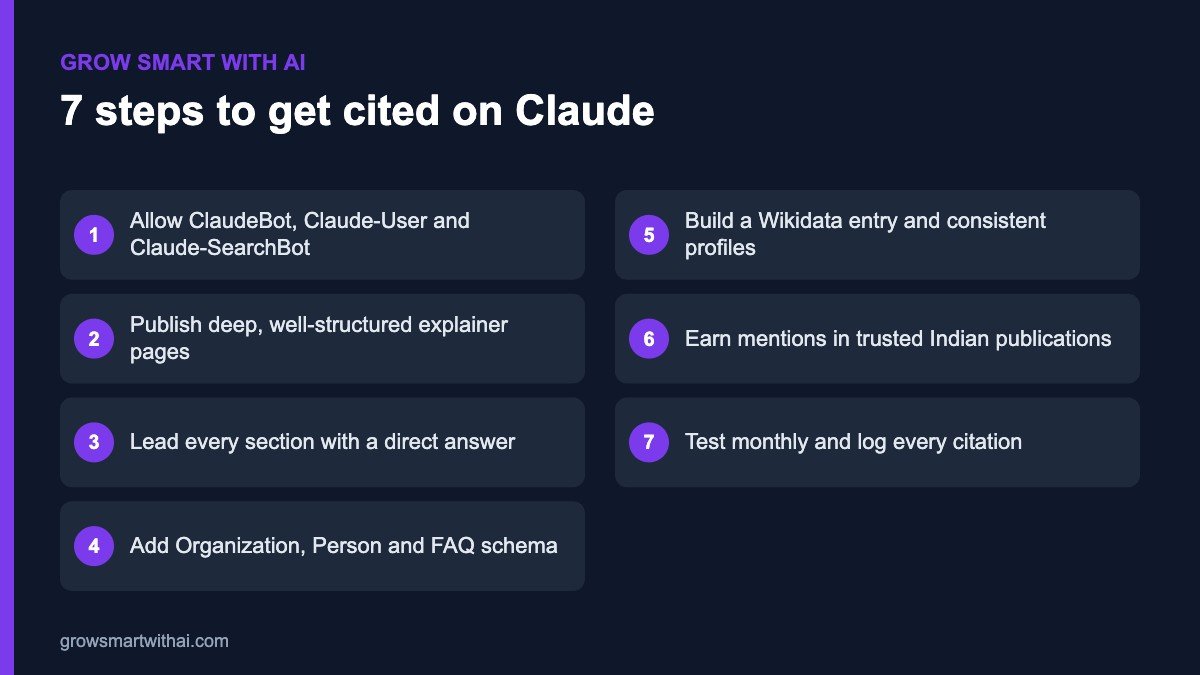
These steps build on the four quick actions above. Together they cover access, content, structure and trust — the four things Claude needs before it will cite a source with confidence.
Step 1: Let Claude read your site
Check robots.txt for any rule that blocks ClaudeBot, Claude-SearchBot or Claude-User. Then ask your host whether a firewall such as Cloudflare’s bot protection is blocking AI crawlers. Many Indian sites on shared hosting block them by default without the owner knowing.
Step 2: Publish deep explainer pages
Claude tends to favour pages that explain a topic fully. For each core service, write one comprehensive page: what it is, who it is for, how it works, what it costs, common mistakes and FAQs. A single 2,000-word guide usually earns more citations than five thin posts on the same subject.
Step 3: Lead every section with a direct answer
Start each section with one or two sentences that answer the heading’s question plainly. Then add detail. This “answer first” structure makes it easy for Claude to quote you accurately — and accurate quotes are what citations are built on.
Step 4: Add structured data
Organization, Person, Article and FAQPage schema help any AI system understand who you are and what each page covers. See our schema markup guide for ready-to-use examples.
Step 5: Make your brand a clear entity
Use the same company name, description, founders and location on your website, LinkedIn, Crunchbase, Google Business Profile and Wikidata. Consistency across independent sources is one of the strongest signals that a brand is real and established.
Step 6: Earn mentions in trusted publications
Claude’s search results often include established publications, industry blogs and reference sites. A founder interview in YourStory, Inc42 or a respected trade journal, a guest article on an industry body’s website, or a quote in a newspaper feature gives Claude an independent source that mentions you.
Step 7: Test every month
Turn on web search in Claude and ask the questions your buyers ask. Record whether you are cited, which page is linked and which competitors appear instead. The pattern will show you exactly which pages to improve next.
Claude vs ChatGPT: What Each One Rewards
Most Indian brands are optimising only for ChatGPT. That leaves an open lane on Claude, which is popular with developers, analysts, consultants and senior professionals — exactly the decision-makers many B2B brands want to reach.
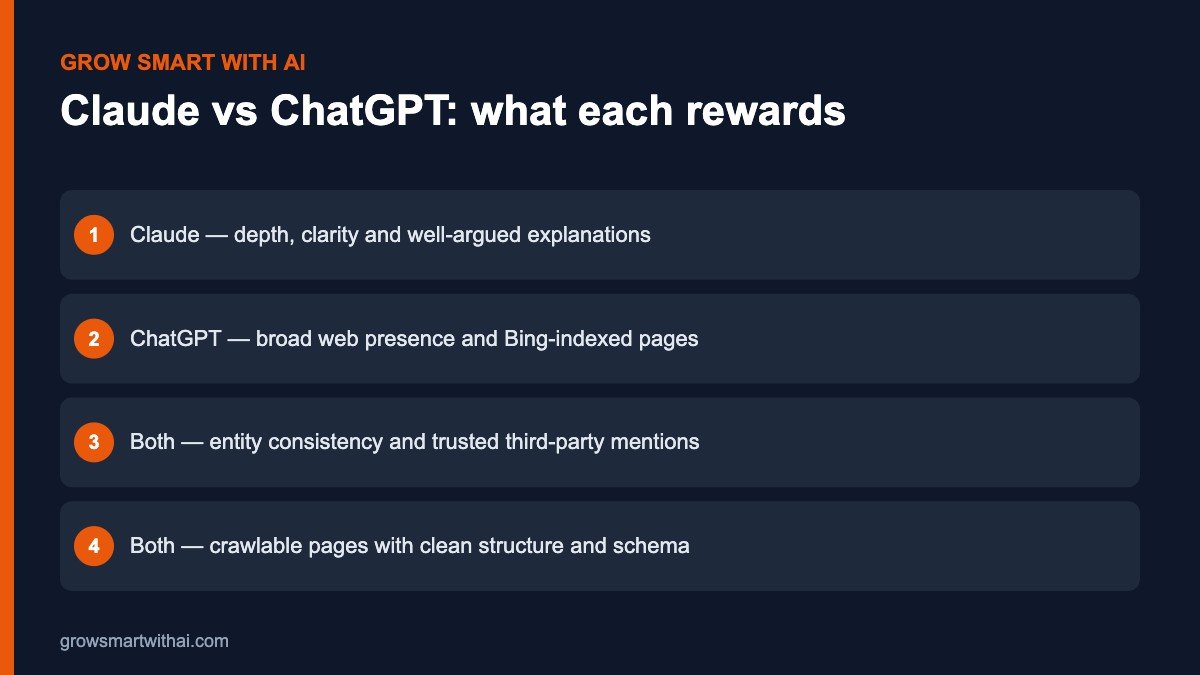
ChatGPT’s search draws heavily on Bing’s index, so Bing Webmaster Tools and IndexNow matter a great deal there. Claude rewards clear, well-reasoned explanations and trustworthy sources. The good news is that the foundations overlap: crawlable pages, strong structure, schema and consistent entity data help you on both. Our guide to ChatGPT visibility covers the other side.
Common Mistakes That Stop Brands Getting Cited on Claude
- Blocking AI crawlers by accident. A security plugin or CDN rule can silently block every Anthropic user agent.
- Thin, templated pages. Pages that repeat the same phrases with little substance are unlikely to be chosen as a source.
- Key facts hidden in images or PDFs. Put prices, services, locations and team details in plain HTML text.
- No author information. Anonymous content is harder to trust. Add author names, bios and credentials to every article.
- Inconsistent company details. Different names, founding years or descriptions across profiles weaken your entity.
- Measuring only Google rankings. AI citations need their own tracking. A simple monthly prompt log is enough to start.
How to Track Your Claude Citations
Create a sheet with ten prompts that match your services, such as “best GEO consultants in India” or “how to add schema markup to a WordPress site”. Each month, run them in Claude with web search on and record three things: whether your brand is named, whether your site is linked, and which page is cited.
In Google Analytics 4, add a filter for referral traffic from claude.ai. Visits from Claude are usually small in number but high in intent — people who arrive after reading a detailed AI answer are often ready to talk. Over three to six months, you should see both citations and referral visits rise as the steps above take effect.
Get cited on Claude: the short version
Let Claude’s crawlers in. Publish fewer, deeper pages that answer real questions directly. Add schema and keep your brand details consistent everywhere. Earn a handful of genuine mentions on trusted Indian sites, then test monthly. That is the whole playbook for Indian brands that want to get cited on Claude in 2026 — and almost none of your competitors are doing it yet.
What Makes a Page Worth Citing on Claude
When Claude searches the web, it usually reads several pages before writing an answer. It then cites the ones that best support each claim. In practice, the pages that get cited tend to share five qualities.
- They answer the question directly. The key fact appears in the first lines of a section, not buried in the fourth paragraph.
- They are specific. Real numbers, named examples, prices in rupees, timelines in weeks. Specific claims are easier to cite than general opinions.
- They are clearly organised. Descriptive headings, short paragraphs, lists and tables make it simple to find and quote the right passage.
- They show who is behind them. An author name, a short bio, a company page and contact details all add credibility.
- They are consistent with other sources. If your page says something that matches what trusted third-party sites say, it is a safer source to cite.
None of these require a big budget. They require care. A small Indian consultancy with five excellent, well-structured explainer pages can be cited on Claude ahead of a large competitor with hundreds of thin ones.
A 90-Day Plan for Indian Brands
If you want a simple timeline, use this one. It assumes a small team and a few hours a week.
- Days 1–7: Access. Audit robots.txt and your firewall, allow Anthropic’s crawlers, submit your sitemap to Google and Bing, and add an llms.txt file.
- Days 8–30: Foundations. Rewrite your home, about and main service pages with answer-first sections. Add Organization, Person and FAQPage schema. Align your LinkedIn, Crunchbase and Google Business Profile details.
- Days 31–60: Depth. Publish two or three comprehensive explainer guides on the topics your buyers search most. Create or improve your Wikidata entry.
- Days 61–90: Trust. Pitch two founder interviews or expert quotes to Indian business publications, and contribute one guest article to an industry association site. Run your monthly Claude prompt test and compare it with day one.
Most brands that follow this plan see their first Claude citations within three months, usually on long-tail questions first and broader category questions later.
Can I pay to get cited on Claude?
No. Claude does not sell placement in its answers. The only way to get cited on Claude is to be a genuinely useful, accessible and trustworthy source for the question being asked.
Does blocking ClaudeBot stop Claude from citing me?
Blocking ClaudeBot limits what Claude can learn from your site for training. Blocking Claude-SearchBot and Claude-User limits what it can find and read in search. If you want citations, allow the search and user agents at a minimum.
Example: What a Claude Citation Looks Like
Imagine an HR head in Mumbai asks Claude, with web search on: “Which companies in India run AI training workshops for corporate teams?” Claude searches, reads several pages and writes a short answer. Next to each company it names, it shows a small citation that links to the page it used.
The brands that appear are rarely the ones with the biggest ad budgets. They are the ones with a page that clearly says, in plain text near the top, “We run half-day and full-day AI workshops for corporate teams across India”, followed by formats, audiences, outcomes, pricing guidance and client examples. Claude can quote that page with confidence, so it does.
Now picture the same company with a beautiful home page that says only “Empowering the future of work”. There is nothing concrete to quote. Claude moves on to the next source.
That contrast is the heart of this guide. To get cited on Claude, write pages that a careful researcher would be happy to reference: clear claims, real details and an obvious expert behind them. Do that consistently and the citations follow — on Claude, and on every other AI assistant your customers use.
Quick self-check before you publish
- Does the first paragraph answer the main question in plain words?
- Would a stranger know who wrote this and why they are qualified?
- Are the important facts in text, not only in images or videos?
- Is there at least one specific number, example or price?
- Could Claude’s crawlers access this page without logging in?
Start small: pick your single most important service page this week, rewrite it with the self-check above, and allow Anthropic’s crawlers in robots.txt. Then run your first Claude prompt test so you have a baseline to measure every future improvement against.
FAQ
Does Claude search the web?
It depends on deployment — some Claude integrations have live web search, others answer purely from training data. Assume both are possible and optimize for durable, high-quality content either way.
How is Claude different from ChatGPT for brand visibility?
Claude leans more on depth and structure in existing sources; ChatGPT (especially with browsing) leans more on recency and breadth of mentions. Optimizing for one usually helps the other, but Claude rewards fewer, deeper pages more than many shallow ones.
How long does it take to get cited on Claude?
There’s no fixed timeline — it depends on whether your content is already in a widely-used training corpus or needs to be picked up through connected search. Wikidata and Wikipedia entries tend to show results faster than net-new content.
Book a free 45-minute live GEO audit →
More guides: Grow Smart with AI blog.
Further reading: Bing Webmaster Tools, Schema.org documentation, and Google structured data intro.
Get cited on Claude AI India continues to matter as Indian buyers shift from Google-only research to ChatGPT, Perplexity, and Copilot. Consistent entity signals, schema markup, llms.txt, Bing Webmaster Tools verification, and AEO-structured content compound over 90 days. Brands that implement these steps early tend to own category answers before competitors catch up.
Practical note on get cited on Claude AI India: Indian brands should document entities, publish corroborating pages, and measure LLM citations monthly.
Teams implementing get cited on Claude AI India often combine schema markup, Bing Webmaster Tools, and AEO-formatted FAQs for faster AI visibility.